
Leather Sewing Machines: Walking-Foot vs Cylinder-Arm
Which machine sews leather: household, walking-foot, cylinder-arm or hand-powered stitchers, thickness in oz and mm, thread and needle sizes, and 2026 prices.
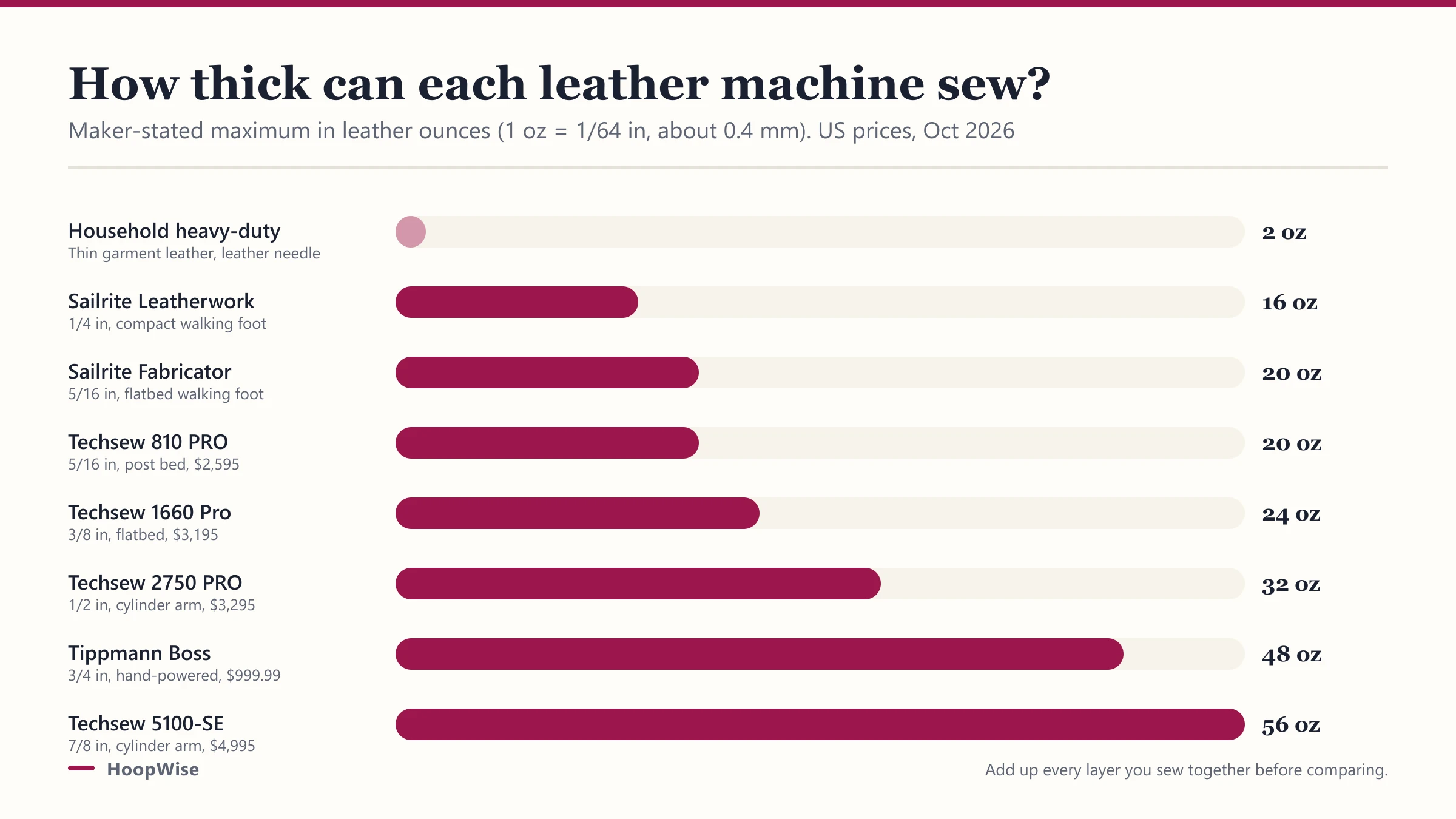
Leather is the material where household machines stop most abruptly. A thin lambskin jacket is fine on the machine you own; two layers of belt leather are not. The deciding number is the total thickness under the needle, so this page measures everything in leather ounces, inches and millimeters and maps each machine onto that scale.
What makes a sewing machine a leather sewing machine?
A leather sewing machine is one that can push a large needle and heavy bonded thread through firm, thick material and feed it without the top layer sliding. Three features make that possible: a feed system that moves the leather from above as well as below, enough presser-foot lift and needle force for the stack, and a hook and tension system sized for thread far heavier than household thread.
Most machines sold for leather use compound feed. Techsew describes it on its machines as alternating presser feet plus a needle that moves with the material plus the feed dog. Household machines feed only from below, which is why leather sticks, stretches or skips stitches on them.
If you sew mostly denim and canvas with an occasional leather trim, our heavy-duty sewing machine guide covers what a household machine can manage.
How thick is your leather, in ounces, inches and millimeters?
Leather thickness is sold in ounces, and one ounce equals 1/64 in, about 0.4 mm. Add the layers you sew together to get the number to compare with a machine’s maximum.
| Leather weight | Inches | Millimeters | Machines whose stated maximum reaches this thickness |
|---|---|---|---|
| 2 oz | 1/32 in | 0.8 mm | Household heavy-duty machines with a leather needle (Singer: light-to-medium leather) |
| 4 oz | 1/16 in | 1.6 mm | Test first on a household machine; any leather machine below |
| 8 oz | 1/8 in | 3.2 mm | Sailrite Leatherwork and every machine below |
| 16 oz | 1/4 in | 6.4 mm | Sailrite Leatherwork (16 oz or 1/4 in) |
| 20 oz | 5/16 in | 7.9 mm | Sailrite Fabricator (20 oz); Techsew 810 PRO (5/16 in) |
| 24 oz | 3/8 in | 9.5 mm | Techsew 1660 Pro (3/8 in, 10 mm) |
| 32 oz | 1/2 in | 12.7 mm | Techsew 2750 PRO and 4800 PRO (1/2 in) |
| 48 oz | 3/4 in | 19 mm | Tippmann Boss (3/4 in) |
| 56 oz | 7/8 in | 22 mm | Techsew 5100-SE (7/8 in) |
A worked example: a belt made of two layers of 8 oz leather is 16 oz, or 1/4 in, which is the stated limit of the Sailrite Leatherwork. A holster folded over with a welt can be three layers of 8 oz, 24 oz or 3/8 in, before the thread crosses a seam. Leather is sold in ranges such as 8 to 9 oz, so measure your actual hides with a gauge.
Which leather sewing machines are worth comparing?
These machines cover the range from household to heavy stitcher. Thickness, thread and price come from each maker’s or dealer’s listing, checked in October 2026.
| Machine | Feed and bed | Max thickness (maker) | Thread range | US price, Oct 2026 |
|---|---|---|---|---|
| Singer Heavy Duty 4452 | Household; walking foot included | Light-to-medium leather (Singer) | Household thread | $219.99 |
| Sailrite Ultrafeed LSZ | Portable walking foot, flatbed, straight and zigzag | 3/8 in foot lift | See Sailrite | $1,495 (110V package) |
| Sailrite Leatherwork | Walking foot, compact, 550 W servo | 16 oz or 1/4 in | See Sailrite | See Sailrite |
| Sailrite Fabricator | Compound walking foot, flatbed, 1,108 spm | Leather up to 20 oz; 9/16 in lift | See Sailrite | See Sailrite |
| Techsew 1660 Pro | Compound walking foot, flatbed, 2,500 spm | 3/8 in (10 mm) | #46 to 210 | $3,195 |
| Techsew 2750 PRO | Compound walking foot, 10.5 in cylinder arm, flatbed attachment included | 1/2 in (13 mm) | #46 to #207 | $3,295 (U-table); $3,544 (pedestal) |
| Techsew 5100-SE | Compound walking foot, 16.5 in cylinder arm, flatbed attachment, 1,200 spm | 7/8 in (22 mm) | #69 to #415 | $4,995 |
| Tippmann Boss | Hand-powered, cylinder bed, 6.5 in throat | 3/4 in | 69 to 415 | $999.99 |
| Techsew 810 PRO | Post bed, roller feed | 5/16 in, light to medium leather | #23 to #92 | $2,595 |
Prices for the Singer and the Ultrafeed are from the maker listings cited in our heavy-duty guide; Sailrite did not show prices on the Leatherwork and Fabricator pages we checked. For lighter canvas and upholstery work, the Consew CP206RL portable walking-foot machine listed at $752 at SewingMachinesPlus.
Flatbed or cylinder arm: which bed do you need?
Choose a flatbed for flat goods and a cylinder arm for anything you sew around. A flatbed machine supports wallets, belts, straps, notebook covers and upholstery panels on a wide surface. A cylinder arm is a narrow horizontal post you slide work over, which lets you sew inside bags, around boot shafts, along holster seams and into tight corners.
You do not always have to choose. Techsew includes a flatbed table attachment with the 2750 PRO and 5100-SE and sells its aluminum flatbed attachment for the 2750, 4800, 5100, 810 and 2600 for $279 to $299. Tippmann sells the Boss with a flatbed assembly as an option. A post-bed machine like the Techsew 810 PRO is a third shape, for three-dimensional items such as shoes and small curved goods.
The cylinder arm’s size matters for bags: Techsew lists a 10.5 in long, 3 in diameter arm on the 2750 PRO. A narrow arm reaches into small pouches; a long arm reaches deeper into large bags.
Is a hand-powered leather stitcher worth it?
A hand-powered stitcher is worth it for low volume and very thick work on a budget. The Tippmann Boss ($999.99, October 2026) forms a lockstitch on every pull of the handle, needs no electricity, sews up to 3/4 in, takes thread from 69 to 415, adjusts from 4 to 16 stitches per inch and weighs 21 lb. Tippmann recommends 207 (Tex 210) and 277 (Tex 270) bonded nylon.
The trade is speed and one free hand: every stitch is one pull, so long seams take time, and you guide the work with one hand. For a saddle maker or a holster maker sewing a few pieces a week, that is fine. For bags and wallets in volume, a powered walking-foot machine at $3,000 to $5,000 is faster.
Which thread and needle sizes go with leather machines?
Leather machines use bonded nylon or bonded polyester thread, sized by V-number (Tex is close to the same number). Each machine lists the range its tension and hook accept.
| Bonded thread size | Tex | Common use | Machines in the table that accept it |
|---|---|---|---|
| V-46 | Tex 45 | Light leather goods, upholstery | Techsew 1660 Pro, 2750 PRO |
| V-69 | Tex 70 | Wallets, light bags, upholstery | Techsew 1660 Pro, 2750 PRO, 5100-SE, 810 PRO, Tippmann Boss |
| V-92 | Tex 90 | Bags, heavier upholstery | Techsew 1660 Pro, 2750 PRO, 5100-SE, 810 PRO, Tippmann Boss |
| V-138 | Tex 135 | Bags, straps, light belts | Techsew 1660 Pro, 2750 PRO, 5100-SE, Tippmann Boss |
| V-207 | Tex 210 | Belts, holsters, sheaths | Techsew 1660 Pro, 2750 PRO, 5100-SE, Tippmann Boss |
| V-277 | Tex 270 | Holsters, tack | Techsew 5100-SE, Tippmann Boss |
| V-346 and V-415 | Tex 350 and 400 | Saddles, harness | Techsew 5100-SE, Tippmann Boss |
Needles follow the thread: heavier thread needs a bigger needle with a bigger eye. Techsew lists sizes 18 to 24 (135x17 or 135x16) for the 2750 PRO and 19 to 27 (7x3, 7x4, 794) for the 5100-SE. Leather points such as LR and diamond cut a slit instead of pushing a hole, and each leaves a different stitch look; Techsew sells Organ 794 diamond-point and 135x8 LR-point needles. On a household machine, use the leather needle in the 130/705H system. Our needle sizes guide and sewing thread guide cover household sizes.
What about voltage, oil and setup?
US leather machines ship with 110 V motors: Techsew lists 110 V servo motors on its 1660 Pro, 2750 PRO and 5100-SE, and Sailrite’s Leatherwork and Fabricator use its 550 W Workhorse servo. Do not change a motor or plug yourself; the manual and the dealer handle that.
Industrial leather machines need oil on the schedule in their manual; Techsew sells a clear industrial sewing machine oil for this, and our sewing machine oil guide explains why household oils are not a substitute. The machines with tables arrive as head, table and motor, like other industrial machines; our industrial sewing machine guide covers setup, servo motors and buying used.
Who should not buy a leather sewing machine?
- You sew garment leather and suede occasionally. A household machine with a leather needle and a walking or non-stick foot handles it.
- You make a few wallets or belts a year. Hand stitching with an awl or a pricking iron costs very little and gives the saddle-stitch look many leatherworkers prefer.
- You need one machine for garments too. Most leather machines sew a straight stitch through heavy work; they are poor at light fabric, knits and buttonholes.
- Your work is mostly canvas and upholstery. A portable walking-foot or an upholstery walking-foot machine may cover it for less, as the heavy-duty and industrial guides show.
Sources and price checks (October 2026): Techsew product listings for the 1660 Pro, 2750 PRO, 4800 PRO, 5100-SE and 810 PRO, its flatbed attachment and Organ needle listings; Tippmann Industrial’s Boss product page and FAQ; Sailrite’s Ultrafeed, Leatherwork and Fabricator pages; SewingMachinesPlus for the Consew CP206RL; Singer and Sailrite prices as cited in our heavy-duty sewing machine guide.
Frequently asked questions
Quick answers to what readers ask us most
Can a regular sewing machine sew leather?
Thin garment leather and suede, yes, with a leather needle, a longer stitch and a walking or non-stick foot. Singer says its heavy-duty household line handles light-to-medium leather with the correct needle. Belt, holster and saddle leather needs a walking-foot leather machine or a hand-powered stitcher.
What is the best sewing machine for thick leather?
It depends on the total thickness you sew. Techsew rates its 2750 PRO cylinder-arm machine for leather up to 1/2 in ($3,295 in October 2026), Tippmann its hand-powered Boss up to 3/4 in ($999.99), and Techsew its 5100-SE heavy stitcher up to 7/8 in ($4,995). Add up your layers in ounces before choosing.
What is a walking foot sewing machine?
It is a machine whose presser foot feeds the material along with the feed dogs, so the top layer moves in step with the bottom. Leather and upholstery machines usually go further with compound feed: alternating presser feet, a needle that moves with the material, and the feed dog. This is a different thing from the walking foot attachment sold for household machines.
What thread do leather sewing machines use?
Bonded nylon or bonded polyester, sized by V-number or Tex. Light leather goods often use V-69 (Tex 70) to V-138 (Tex 135); belts and holsters use V-207 (Tex 210) or V-277 (Tex 270). Tippmann recommends 207 and 277 for its Boss. Each machine lists the thread range it accepts.
What needles do leather sewing machines use?
Household machines use a leather needle in the 130/705H system. Industrial leather machines use their own systems, such as 135x16 or 135x17 on the Techsew 2750 PRO and 794 or 7x3 on the Techsew 5100-SE and Tippmann Boss, with leather points like LR or diamond that cut the leather rather than push through it.