
Heavy-Duty Sewing Machines: What They Can and Cannot Sew
What a household heavy-duty sewing machine handles (denim, canvas, light leather), where it stops, Singer and Brother prices, and when to go walking-foot.
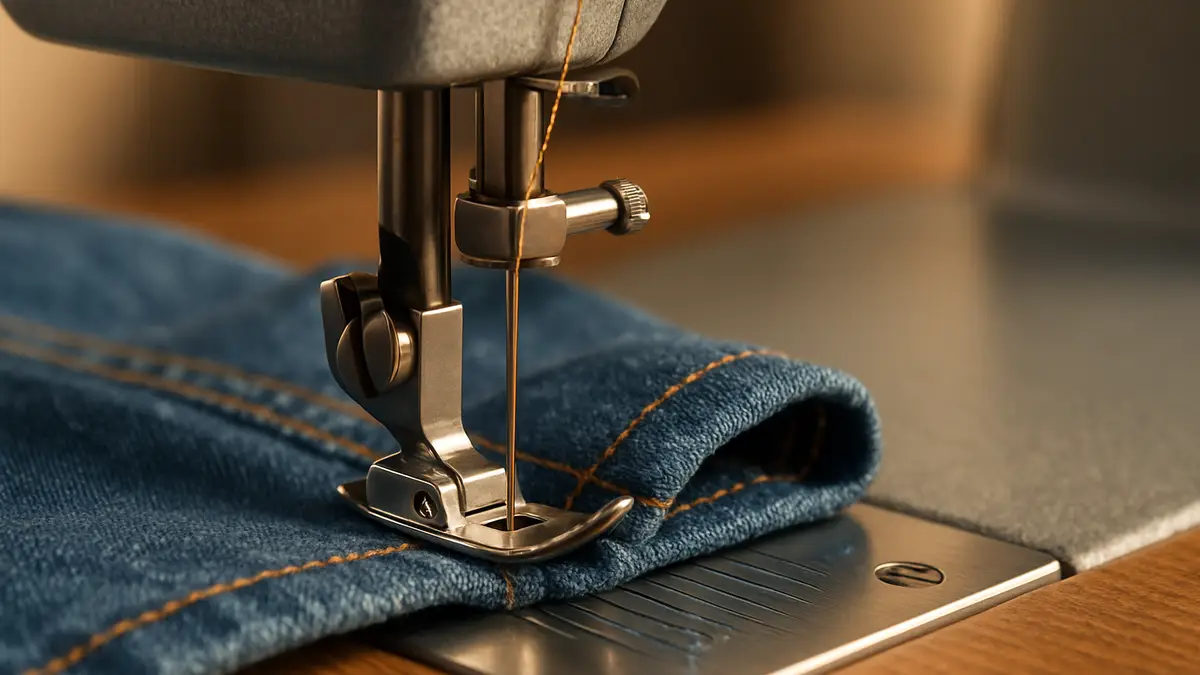
“Heavy duty” on a household sewing machine is a marketing label, not a standard. It usually means a metal frame, a stronger motor and a higher presser-foot lift. Those features help with denim and canvas, but they do not turn a household machine into an industrial one. This page draws that line clearly.
What makes a sewing machine heavy duty?
A heavy-duty sewing machine is a household sewing machine built to feed thick fabrics more reliably than a standard model, through a metal frame, a stronger motor, an extra-high presser-foot lift and often a stainless steel bed plate. Singer describes its 4423 as having a heavy-duty metal frame, a stainless bed plate and 50 percent more power for thick fabrics; Brother describes the ST150HDH as having a metal interior frame and 7-point box feed dogs.
What does not change: the needle system, the size of thread the tension and needle eye will take, the room under the arm, and the fact that feeding comes from the feed dogs underneath. Those limits decide what a household machine can sew far more than the motor claim on the box.
Which heavy-duty sewing machines are worth comparing?
These are common US heavy-duty household models, with figures from Singer, Brother and Sailrite product pages in October 2026. Sale prices change often; the regular price is shown where the maker lists one.
| Machine | Price (Oct 2026) | Rated speed | Built-in stitches | Heavy-duty features | Feet worth noting |
|---|---|---|---|---|---|
| Singer Heavy Duty 4423 | $229.99 (MSRP $289.99) | 1,100 spm | 23 | Metal frame, stainless bed plate, extra-high lift, adjustable presser-foot pressure; 14.6 lb | Standard feet |
| Singer Heavy Duty 4452 | $219.99 (listed down from $319.99) | 1,100 spm | 32 | Metal frame, stainless bed plate, extra-high lift; 14.6 lb | Walking foot and non-stick foot included |
| Brother ST371HD | $239.99 | 800 spm | 37 | Metal needle plate; needles 11, 14, 16 included | Non-stick foot included |
| Brother ST150HDH | $339.99 | 850 spm | 50 | Metal interior frame, 7-point box feed | Walking foot included; two size 14 heavy-duty needles |
| Sailrite Ultrafeed LSZ (110V package) | $1,495.00 | Not compared | Straight and zigzag | Portable walking-foot machine | Walking foot is the machine’s feed system |
The Sailrite is in the table as the step past household heavy-duty machines, not as a rival: it is a portable walking-foot machine for canvas, marine and upholstery work.
What can a heavy-duty sewing machine sew?
A household heavy-duty machine handles most home projects in thick fabric, provided you match the needle and slow down over bulk. Singer’s heavy-duty line page names multiple layers of denim, canvas, and light-to-medium-weight leather with the correct needle.
| Job | Household heavy-duty machine | What helps |
|---|---|---|
| Hemming jeans, including the side seam hump | Yes | Jeans needle, hump jumper or shim, handwheel over the hump |
| Canvas tote bags with 3 to 4 layers at the handles | Yes | Jeans needle, longer stitch, slow speed |
| Garment leather, suede, light upholstery leather | Yes, light to medium weight | Leather needle, walking or non-stick foot, longer stitch |
| Vinyl, oilcloth, laminated cotton | Yes | Non-stick or walking foot |
| Outdoor cushion covers, simple slipcovers | Yes | Walking foot over long seams |
| Thick belt, saddle or holster leather | No | Industrial walking-foot or leather machine |
| Heavy upholstery over welting, foam-backed vinyl | Borderline to no | Walking-foot machine |
| Sails, heavy webbing straps in many layers | No | Walking-foot or industrial machine |
What can a heavy-duty sewing machine not sew?
It cannot reliably sew thick, firm materials that need more feed than feed dogs alone provide or more needle force than a household drive delivers. Three groups cause trouble:
- Thick vegetable-tanned leather for belts, holsters, sheaths and saddlery. The material is too firm and thick for household feed and needle force; skipped stitches, broken needles and a strained machine are the usual results.
- Many layers of slippery or spongy material, such as upholstery fabric over welting cord or vinyl with foam backing. The top layer drags and the stitches skip, even with a walking foot attachment.
- Heavy bonded thread. Bonded nylon or polyester in the heavier sizes used for leather goods and outdoor gear can be too thick for a household machine’s tension discs and needle eye. Test a scrap and check the manual before buying spools of it. Our sewing thread guide lists the heavy-duty threads and the needle sizes that go with them.
If your main project falls into one of these, skip the household heavy-duty tier and look at walking-foot machines from the start.
Why is stitches per minute the wrong number to compare?
Speed is not what pushes a needle through six layers of denim. A rated 1,100 stitches per minute tells you how fast the machine sews on easy fabric, not how much force it applies at the slow speeds you use on a thick seam. Over bulk you should sew slowly, and at the thickest point turn the handwheel by hand.
The numbers that matter more are hard to find on spec sheets: presser-foot lift height, whether presser-foot pressure is adjustable (it is on the Singer 4423), whether a walking foot is included or available, and whether the frame is metal. The table above lists what the makers publish. Treat percentage motor claims as marketing language rather than a measured comparison between brands.
How do you sew thick seams on a household machine?
Most thick-seam failures come from technique, not the machine. Five habits fix most of them:
- Use the right needle. A jeans or denim needle in 100/16 or 110/18 for heavy denim and canvas; a leather needle only for leather, since its cutting point can weaken woven fabric. Our needle size chart matches needle to fabric.
- Level the presser foot at a hump. A hump jumper or a folded scrap under the back of the foot keeps it level as it climbs a flat-felled seam.
- Turn the handwheel over the thickest point. Let the motor run on the flat sections only.
- Lengthen the stitch. Short stitches in thick fabric pile up and perforate it.
- Reduce bulk first. Trim or grade seam allowances and flatten bulky seams before sewing across them.
A walking foot, included with the Singer 4452 and the Brother ST150HDH, feeds the top layer in step with the bottom and helps most on vinyl, leather and long seams in layered canvas.
When do you need a walking-foot or industrial machine?
You need a walking-foot or industrial machine when thick or layered material is your main work rather than an occasional project. Three signals: you sew leather goods regularly, you sew canvas, sailcloth or webbing for outdoor gear, or you take upholstery jobs for pay.
The Sailrite Ultrafeed LSZ is the common portable step up, at $1,495 for the 110V package in October 2026. Beyond it are full industrial walking-foot machines with a table and servo motor, which mostly sew straight stitch only, take floor space, and suit a dedicated workshop. Both are poor general-purpose machines: you would still want a household machine for garments, buttonholes and knits.
Is a heavy-duty machine the right first sewing machine?
It can be, if your projects lean toward denim, canvas bags and home decor. The Singer 4423 and 4452 are often bought as first machines for that reason. If you mostly sew cotton, knits and garments, a standard beginner machine is lighter, often has more stitch options for the money, and is easier to learn on; see our best sewing machines for beginners.
For quilting, throat space and feed matter more than motor strength, so a heavy-duty model is rarely the best pick; our best sewing machines for quilting covers what to look for. Finishing raw edges on thick fabric is a separate job; see serger vs sewing machine.
Who should not buy a heavy-duty sewing machine?
- Leatherworkers making belts, holsters or saddlery. Buy a machine built for leather from the start.
- Upholsterers and canvas or marine sewists doing paid work. A walking-foot machine pays for itself in fewer skipped stitches and broken needles.
- Quilters. Throat space and an even feed matter more than motor claims.
- Anyone who also wants embroidery. A heavy-duty machine does not embroider; if you want both in one machine, read combo sewing and embroidery machines.
Sources and price checks (October 2026): Singer product pages for the Heavy Duty 4423 and 4452 and Singer’s heavy-duty collection page (fabric statement); Brother USA product pages for the ST150HDH and ST371HD; Sailrite’s Ultrafeed LSZ 110V package listing.
Frequently asked questions
Quick answers to what readers ask us most
Can a heavy-duty sewing machine sew leather?
Light-to-medium leather, yes, with a leather needle, a longer stitch and a walking or non-stick foot; Singer says its heavy-duty line handles light-to-medium leather with the correct needle. Thick belt, saddle or holster leather needs an industrial walking-foot machine.
What is the difference between a heavy-duty and a regular sewing machine?
A heavy-duty household machine adds a metal frame, a stronger motor, a higher presser-foot lift and often a stainless bed plate, so it feeds thick layers more reliably. It is still a household machine with the same needle system and similar limits on thread size.
Is the Singer Heavy Duty 4423 good for beginners?
It works for beginners who mostly sew denim, canvas and home decor, and Singer listed it at $229.99 in October 2026. If you mostly sew cotton and knits, a standard beginner machine is lighter and easier to handle.
Can a heavy-duty sewing machine sew upholstery?
Light upholstery jobs such as cushion covers and simple slipcovers, yes. Thick upholstery fabric over welting, many layers at once, or vinyl with foam backing is where household machines skip stitches; a walking-foot machine handles that work.
Do heavy-duty sewing machines sew faster?
Some are rated faster, such as 1,100 stitches per minute for the Singer 4423, but speed is not what gets a needle through thick layers. Sew thick seams slowly, or turn the handwheel by hand over the bulkiest point.