
Best Sewing Machines for Quilting: Throat Space and Picks
Quilting machines compared on throat space, walking foot, speed and US price (Oct 2026): Brother XR3774 and PQ1500SL, Juki TL-2010Q, and when to step up.
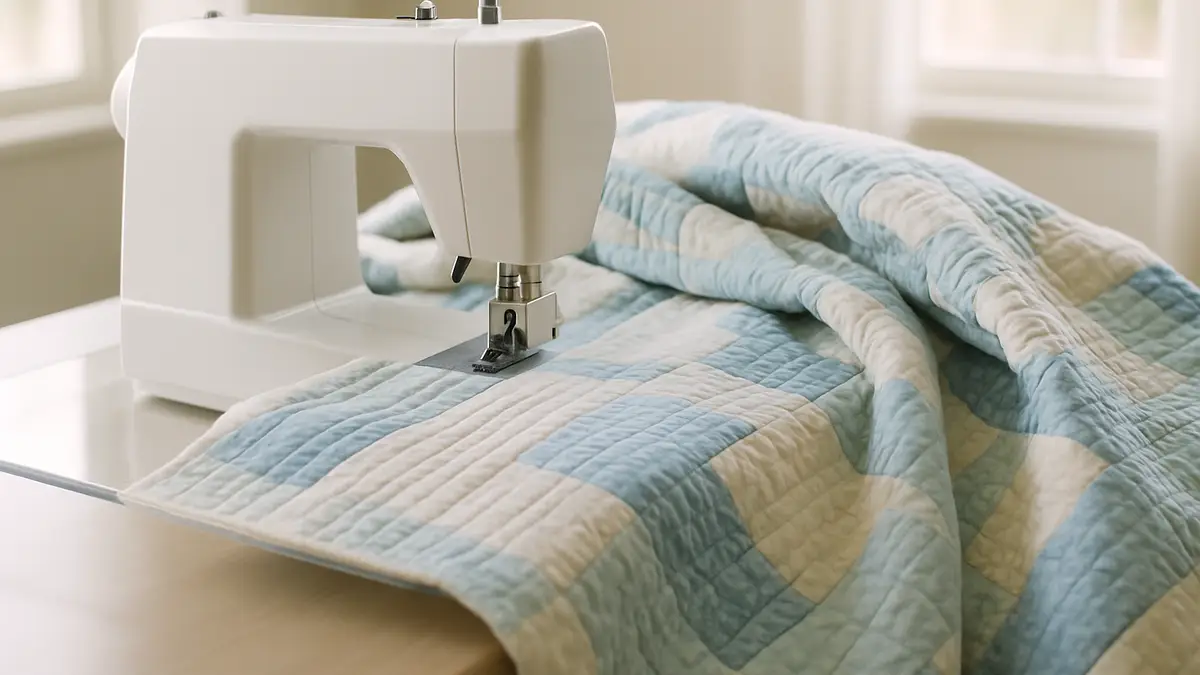
A quilting machine is a sewing machine with the room and the feed system to push three layers of fabric and batting through it without shifting. Price is not the main variable. Throat space, a walking foot and a large table decide how pleasant quilting feels, and they decide it more than stitch count does.
What makes a sewing machine good for quilting?
Four specs decide quilting comfort: throat space, the feed system, straight-stitch quality and the table. Throat space (also called harp space or arm space) is the distance from the needle to the machine’s body, and it limits how much rolled-up quilt fits under the arm. The feed system has to move a thick, slippery quilt sandwich evenly; a walking foot or built-in dual feed does that. A good straight stitch matters more than 200 decorative stitches, because quilting is almost all straight stitch or free-motion. A wide extension table carries the quilt’s weight so it does not drag the needle off line. A flush-mount sewing table or cabinet extends that flat surface further.
| Spec | Why it matters for quilting | Minimum for piecing | Comfortable for quilting a throw or larger |
|---|---|---|---|
| Throat space | Room for the rolled quilt | Any | About 8 in or more |
| Feed | Keeps layers aligned | Standard feed dogs | Walking foot or dual feed |
| Straight stitch | Even, flat quilting lines | Any decent machine | Straight-stitch plate or a straight-stitch machine |
| Table | Supports quilt weight | Free arm is fine | Extension table, 20 in wide or more |
| Speed | Long seams, free-motion | 750 spm | 1,000 to 1,500 spm |
Which quilting machines are worth buying in 2026?
The picks below cover four budgets, from a $185 starter to a $2,369 suggested-retail Juki. Prices are US list prices checked in October 2026 on the makers’ sites (Juki publishes a suggested retail price; dealer prices may differ). We have not run hands-on tests; this ranking is built from published specs and what each spec means for quilting.
| Machine | US price (Oct 2026) | Max speed | Arm space published | Walking foot included | Best for |
|---|---|---|---|---|---|
| Brother XR3774 | $184.99 | 800 spm | Not listed | Yes, plus quilting foot and wide table | First quilts on a tight budget |
| Brother CS7000X | $279.99 | 750 spm | Not listed | Yes, plus quilting foot and wide table | Piecing plus small quilts, 70 stitches |
| Brother PQ1500SL | $739.99 | 1,500 spm | 5.7 x 8.6 in | Yes, plus 1/4 in foot | Straight-line quilting, bigger quilts |
| Brother PQ1600S | $999.99 | 1,500 spm | 5.7 x 8.7 in | Pin feed foot (different design) | Same class, bigger 11.1 x 23.3 in table |
| Juki TL-2010Q | $2,169 SRP | 1,500 spm (200-1,500 slider) | 23 in work area with table | Even feed foot | Serious quilters wanting speed control and an auto trimmer |
| Juki HZL-F600 | $2,369 SRP | 900 spm | Not listed | Yes, plus box feed | One machine for quilting and garments, 225 stitches |
Which budget quilting machine should a beginner buy?
The Brother CS7000X ($279.99, October 2026) is the safer first quilting machine because it ships with both a walking foot and a quilting foot plus a detachable wide table, and it has 70 stitches for everything that is not quilting. The Brother XR3774 ($184.99) has the same quilting kit (walking foot, quilting foot, wide table, 8 feet total) with 37 stitches and 800 spm, so it is the cheaper route if decorative stitches do not matter to you.
Both are light (10.5 lb and 12.3 lb), which helps if the machine lives in a cupboard but means they shift more on the table under a heavy quilt. Neither Brother product page lists the throat space, so measure in a store if you plan to quilt anything over throw size. For a broader first-machine list that is not quilting-specific, see our best sewing machines for beginners.
When is a straight-stitch quilting machine worth it?
A straight-stitch machine is worth it once you quilt regularly and want speed and a bigger opening. The Brother PQ1500SL ($739.99, October 2026) sews one stitch at up to 1,500 stitches per minute, almost double a household machine’s 750 to 850 spm, and Brother lists a 5.7 x 8.6 in needle-to-arm space. It ships with seven feet, including a walking foot, a 1/4 in piecing foot and a spring-action free-motion foot, and it weighs 24.2 lb, which keeps it planted.
The Brother PQ1600S ($999.99) is the same idea with a bigger 11.1 x 23.3 in table and a pin feed foot instead of the walking foot. The trade-off for both is real: no zigzag, no buttonholes, no overcasting. They work best as a second machine next to a basic computerized one.
Is the Juki TL-2010Q worth the money?
The Juki TL-2010Q is worth its $2,169 suggested retail price (October 2026, Juki America) for quilters who sew many hours a week and want control rather than raw speed. Its slider sets a hard top speed anywhere from 200 to 1,500 spm, so free-motion quilting stays at a steady pace even when the foot pedal is pressed hard. It adds an automatic thread trimmer that cuts both needle and bobbin threads, a knee lifter, an even feed (walking) foot, a 1/4 in foot and a 23 x 13 in auxiliary table.
Like the Brother PQ machines, it sews straight stitch only. If you want one machine that quilts and also sews garments, the Juki HZL-F600 ($2,369 SRP) pairs a box-feed system and a walking foot with 225 stitches, at a lower 900 spm.
Walking foot or dual feed: which feed system do quilters need?
Quilters need a feed system that moves the top layer as positively as the bottom one, and a walking foot is the cheapest way to get it. A walking foot (even feed foot) has its own feed teeth that move in step with the machine’s feed dogs, so the top fabric does not creep ahead of the batting and backing. Built-in dual feed, such as Pfaff’s IDT, does the same job from the machine body and stays engaged without a foot change.
For straight-line and walking-foot quilting, either works. For free-motion quilting, neither is used: you drop or cover the feed dogs, fit a darning or free-motion foot, and move the quilt by hand. That is where a high top speed and a speed limiter help most.
How much throat space is enough for a home quilter?
About 8 inches to the right of the needle is the practical line between “possible” and “comfortable” for quilting a throw or twin on a domestic machine. Brother lists 8.6 in for the PQ1500SL and 8.3 in for the NQ1700E, and Janome publishes 210 mm (8.3 in) of workspace for its Skyline models. Compact household machines usually sit around 6 inches, which works for piecing and small quilts.
| Quilt size (approx.) | Typical size | Home machine with about 6 in throat | Home machine with 8 to 9 in throat |
|---|---|---|---|
| Baby / wall hanging | 36 x 52 in | Comfortable | Comfortable |
| Throw | 50 x 65 in | Workable, tight | Comfortable |
| Twin | 70 x 90 in | Hard work | Workable |
| Queen / king | 90 x 108 in and up | Not recommended | Hard work; consider a longarm service |
Who should not buy a quilting machine?
Do not buy a dedicated quilting machine if you mostly sew garments, bags or home decor, or if you are not sure quilting will stick. A general machine with a walking foot covers piecing and small quilts, and a heavy-layer project like a canvas tote needs different strengths covered in our heavy-duty sewing machine guide. Garment sewists who want professional knit seams should look at a serger before a quilting machine; our serger vs sewing machine comparison explains the order to buy.
If you also want embroidery, a combo machine may cover both hobbies in one footprint, with trade-offs explained in our combo vs two machines comparison. Anyone planning to quilt king-size tops every month should price a sit-down mid-arm or a longarm rental before spending $2,000 on a domestic machine. Our longarm quilting machine guide compares sit-down and frame models with 2026 prices.
Where do these specs and prices come from?
Every price and spec on this page comes from the maker’s own product page, checked on October 6, 2026: Brother USA for the XR3774, CS7000X, PQ1500SL, PQ1600S and NQ1700E; Juki America for the TL-2010Q and HZL-F600 (suggested retail prices); Janome Australia’s Skyline specification pages for the 210 mm workspace figure. Janome’s US site does not publish prices, so we do not list one. Dealer bundles and sale prices change often, so confirm the current price and what is in the box before you buy.
Frequently asked questions
Quick answers to what readers ask us most
How much throat space do I need for quilting?
For piecing, any throat works. For quilting a throw on a home machine, about 8 in to the right of the needle is comfortable; the Brother PQ1500SL offers 8.6 in and Janome's Skyline line 8.3 in. Compact machines with roughly 6 in can do it, but the rolled quilt fights you on bed and queen sizes.
Is a walking foot necessary for machine quilting?
For straight-line quilting through a quilt sandwich, yes in practice. A walking foot feeds the top layer at the same rate as the feed dogs move the bottom, which stops the top fabric creeping and puckering. Brother includes one with the XR3774, CS7000X and PQ1500SL.
Can a straight-stitch-only machine be my only sewing machine?
Only if you never need zigzag, buttonholes or overcasting. Machines like the Brother PQ1500SL and Juki TL-2010Q sew one stitch, very well and fast. Many quilters own one beside a basic computerized machine for everything else.
Is a longarm better than a home machine for quilting?
A longarm or sit-down mid-arm has 15 in or more of throat and makes large quilts far easier, but it costs thousands and needs floor space. A home machine with 8 to 9 in of throat handles throws and smaller quilts well; many people send large tops to a longarm service instead.
What speed matters for quilting?
Speed matters most for long straight seams and free-motion work. Household machines are rated around 750 to 850 stitches per minute (Brother CS7000X 750, XR3774 800); straight-stitch quilting machines like the PQ1500SL and TL-2010Q reach 1,500 spm.