
Longarm Quilting Machines: Sit-Down vs Frame, 2026 Prices
Longarm quilting machines compared: sit-down vs frame, throat space, frame length vs quilt size, and 2026 US prices for HQ, Juki, Grace, Bernina and Baby Lock.
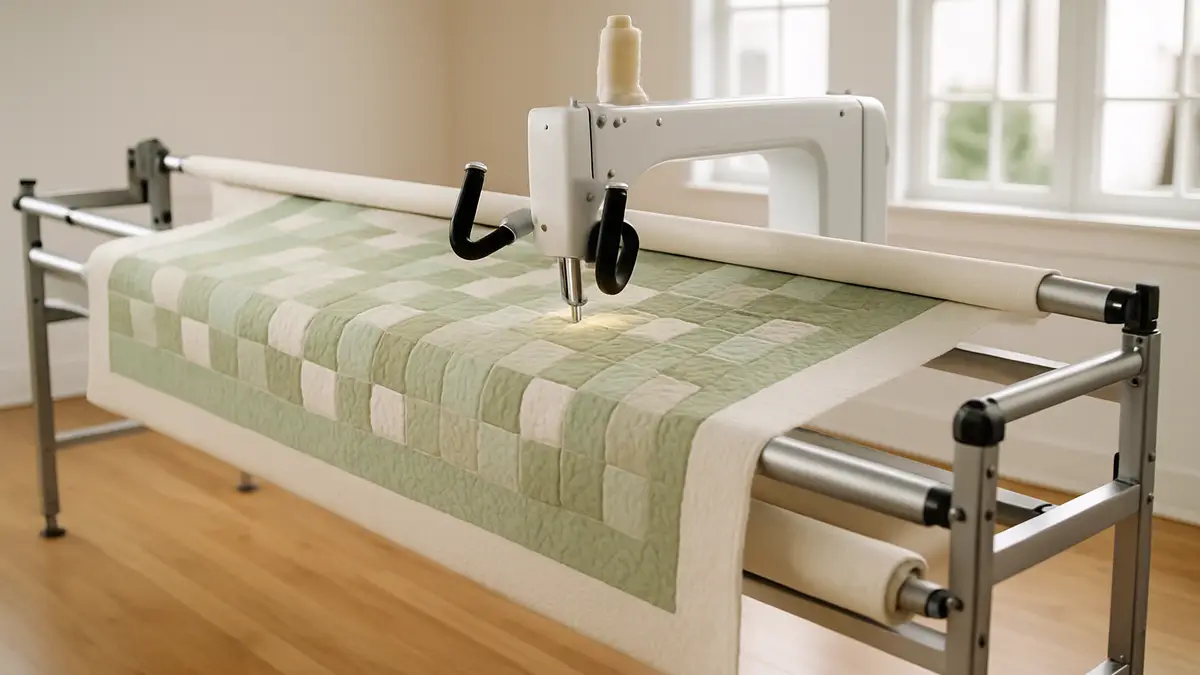
A longarm quilting machine is a sewing head built for one job: quilting through a top, batting and backing with a lot of room under the arm. The step from a domestic machine is large in throat space, price and floor space. This page starts where a home quilting machine stops and compares the formats, the specs that matter and what a full system costs in October 2026.
What is a longarm quilting machine?
A longarm quilting machine is a straight-stitch quilting machine with 15 in or more of throat space, the distance from the needle to the machine body. That space decides how much rolled quilt fits under the arm, or on a frame, how deep a band of the quilt you can stitch before advancing it.
For scale: domestic quilting machines offer about 8 to 9 in, such as the 8.6 in on the Brother PQ1500SL covered in our best sewing machines for quilting. Longarms on the market today run from 15 in (Handi Quilter Moxie, Baby Lock Gallant) to 24 in (Handi Quilter Amara 24, Bernina Q 24).
Longarms sew only a straight stitch, run at 1,700 to 2,500 stitches per minute in the models below, and usually include a stitch regulator. They do not sew garments, zigzag or buttonholes; you keep a domestic machine for piecing and everything else.
Sit-down or frame: which longarm format fits you?
Pick a sit-down longarm if you already free-motion quilt on a domestic machine and want more room; pick a frame if you quilt queen and king tops or want pantographs and computerized patterns.
| Sit-down longarm | Longarm on a frame | |
|---|---|---|
| What moves | You move the quilt | You move the machine head; the quilt stays rolled on rails |
| Throat in current models | 16 to 20 in | 15 to 24 in |
| Floor space | About a large desk | Frame length plus room to walk both sides |
| Large quilts | Possible, but you handle the whole weight | Easier: only the exposed band moves |
| Pantographs and computer guidance | No | Yes, with add-ons |
| Example (Oct 2026) | HQ Moxie ST, 18 in, $5,595 with table | HQ Moxie, 15 in, $4,595 with a 5 ft or 8 ft frame |
A sit-down machine feels familiar to free-motion quilters and fits in a sewing room. A frame takes more space and some practice loading the quilt, but it stops you wrestling a king-size quilt through the throat.
Which longarm quilting machines are worth comparing in 2026?
These are the systems most often compared in the US, with specs and prices from dealer listings (SewingMachinesPlus and Meissner Sewing) or the maker, checked in October 2026. Longarms sell through dealers, so bundles, frames and training differ; compare the same package before comparing prices.
| Machine | Format | Throat | Max speed | Stitch regulation | US price, Oct 2026 | Package as priced |
|---|---|---|---|---|---|---|
| Handi Quilter Moxie | Frame | 15 in (8.25 x 15 in opening) | 1,800 spm | Precision and Cruise, 4 to 18 spi | $4,595 | 5 ft Little Foot or 8 ft Loft frame |
| Baby Lock Gallant | Frame | 15 in, 8.5 in high | 1,800 spm | Precision and Cruise, 4 to 18 spi | About $6,174 | 8 ft Villa frame |
| Grace Qnique 16X | Frame (bought separately) | 16 in | 1,700 spm (Elite 2,100) | Four modes | $4,499.95 | Machine only, no frame or table |
| Handi Quilter Simply Sixteen | Frame | 16 in | Not compared | Not compared | $4,999 | 5 ft Little Foot frame and kit |
| Bernina Q16 | Sit-down as priced (frame packages also sold) | 16 in | Not compared | BERNINA stitch regulator, four modes | $7,999 | Adjustable folding table |
| Handi Quilter Moxie ST | Sit-down | 18 in | 2,100 spm | InSight regulator, 4 to 18 spi | $5,595 | 38 x 38 in InSight table |
| Juki Miyabi J-350QVP-S | Sit-down | 18 x 10 in | 2,200 spm | SmartStitch sensor regulator | $8,299 | 35.4 x 33.7 in table |
| Juki TL-2200QVP | Frame | 18 x 10 in | 2,200 spm | Four modes (Cruise, Precise, Manual, Baste) | $9,999 | 10 ft frame |
| Handi Quilter Amara 20 ST | Sit-down | 20 in | 2,500 spm | Precision and Cruise | $7,595 | InSight table |
| Handi Quilter Amara 20 | Frame | 20 in (9 x 20.5 in opening) | 2,500 spm | Precision and Cruise, 4 to 24 spi | $12,995 | 5 ft Little Foot frame |
| Gammill Vision 2.0 | Frame | See dealer | See dealer | See dealer | Complete system from $16,499 | Gammill’s published starting price |
Two more reference points: the Handi Quilter Amara 24 with a 10 ft Gallery3 frame listed at $16,995, and the Bernina Q 24 with a frame at $27,599 (SewingMachinesPlus, October 2026). Gammill lists its computerized Statler from $42,999. Innova builds its machines near Houston, Texas, and prices them through dealer quotes.
How much throat space do you need?
For a frame longarm, more throat means fewer times you advance the quilt and room for bigger motifs; for a sit-down, it means more of the rolled quilt fits under the arm. A practical way to choose:
- 15 to 16 in (Moxie, Gallant, Qnique 16X, Simply Sixteen, Q16): the entry tier. Comfortable for edge-to-edge meanders and medium blocks.
- 18 in (Moxie ST, Miyabi, TL-2200QVP): the common middle. Larger custom blocks and fewer advances on a king quilt.
- 20 to 24 in (Amara 20 and 24, Q 24): the top of the home market, priced well above $10,000 with a full frame.
Throat height matters too, because a rolled quilt is thick: Juki lists 10 in on its 18 in machines and Baby Lock 8.5 in on the Gallant.
The usable depth on a frame is less than the throat length. Handi Quilter lists a 14 x 48 in quilting space for the 20 in Amara on the 5 ft Little Foot frame, because the rails, rollers and the machine body take some of the room.
How long a frame do you need for your quilt size?
The frame length sets the widest quilt you can load, because the quilt is rolled across the rails from one end of the frame to the other. Usable width is always shorter than the frame, so check the maker’s stated maximum quilt size rather than the frame length alone.
| Frame length | What the makers say or the arithmetic allows | Good for |
|---|---|---|
| 5 ft (60 in) | Amara on the Little Foot frame: 14 x 48 in quilting space | Baby quilts, wall hangings, small throws |
| 8 ft (96 in) | Less than 96 in of usable width | Throws to most queen widths (about 90 in) |
| 10 ft (120 in) | Juki: the TL-2200QVP frame sets up for king or crib | King-size quilts |
| 12 ft (144 in) | Handi Quilter offers its Studio3 frame in 10 or 12 ft | Oversized king and wide-back quilts |
Before buying, measure the room. A 10 ft frame needs a room longer than 10 ft plus space to walk around both ends and stand on both sides of the frame. If the room cannot take that, a sit-down longarm on a table is the better fit; our sewing table guide covers the furniture side.
What does stitch regulation do?
Stitch regulation keeps each stitch the same length whether you move the machine or quilt fast or slow. Sensors read the movement and the machine changes needle speed to match, so curves and slow corners do not pile up tiny stitches.
Most systems offer at least two regulated modes, which differ mainly in what the needle does when you pause; Handi Quilter and Baby Lock call theirs Precision and Cruise, and the manual explains how each behaves at a stop. Juki lists four modes on the TL-2200QVP, adding manual and basting modes, and Bernina says its Q16 regulator has four modes, including manual without regulation. The stitch length range is set in stitches per inch: 4 to 18 on the Moxie and Gallant, 4 to 24 on the Amara.
What does a full longarm setup cost beyond the machine?
Budget for the system, not the head. The price in the table above is the package as listed, and four costs often come on top:
- A bigger frame. Entry packages ship with a 5 ft frame; Handi Quilter sells the 5 ft Little Foot frame alone for $1,395 and Juki a 5 ft frame extension for $1,549 (SewingMachinesPlus, October 2026).
- Computerized guidance. Handi Quilter’s Pro-Stitcher Lite listed at $5,695 and Pro-Stitcher Premium at $12,995; QBOT V3 for the Moxie and Baby Lock Gallant at $5,199; Juki’s QuiltMotion at $6,179.
- Rulers and ruler bases. Ruler work needs a base on the machine; Handi Quilter’s ruler bases ran $149.95 to $159.99.
- Thread and bobbins. Many longarms and industrial machines use larger M-class bobbins rather than the L-class bobbins of domestic machines; check yours before stocking up. Thread weight and fiber choices are in our sewing thread guide.
Shipping, delivery and setup, training classes and a service plan are dealer-specific. Ask for them in writing with the quote.
Are there cheaper ways to finish big quilts?
Yes. Before spending $5,000 or more, compare three routes:
- Rent time on a shop longarm. Many quilt shops rent their machines by the hour after a certification class. You get frame quilting without the floor space.
- Send the top to a longarm quilting service. You piece the top; a longarm quilter quilts it. Pricing is usually by the square inch plus thread and batting, so ask for a quote on your quilt size.
- Use a domestic straight-stitch machine. An 8 to 9 in throat handles throws and lap quilts comfortably; queen and king sizes are hard work but possible in sections.
A longarm makes sense once the rental or service bills for your yearly quilts add up to a real fraction of the machine’s price, or once you start quilting for others.
Who should not buy a longarm quilting machine?
- Quilters who finish a few throws a year. A domestic machine with a walking foot and a large table does that job; see our best sewing machines for quilting.
- Anyone short on floor space. A frame system needs a room of its own; even a sit-down needs a table about 3 ft square or larger.
- Sewists who want one machine for everything. A longarm sews only a straight stitch through a quilt sandwich. For thick canvas and denim, read our heavy-duty sewing machine guide; for production straight seams, the industrial sewing machine guide.
- First-time free-motion quilters. Practice on a domestic machine or a shop rental first; the skill transfers, and you will know which format you prefer.
Sources and price checks (October 2026): SewingMachinesPlus listings for the Handi Quilter Moxie, Moxie ST, Simply Sixteen, Amara 20, Amara 20 ST and Amara 24, Juki TL-2200QVP and J-350QVP-S, Grace Qnique 16X, Bernina Q 24, Pro-Stitcher, QBOT V3, QuiltMotion and frame extensions; Meissner Sewing listings for the Bernina Q16 and Baby Lock Gallant; Gammill’s published system starting prices; Innova’s site for where it builds its machines.
Frequently asked questions
Quick answers to what readers ask us most
How much does a longarm quilting machine cost?
In October 2026, US dealer prices started around $4,500 to $5,000 for a 15 to 16 in machine (Grace Qnique 16X without a frame at $4,499.95; HQ Moxie with a 5 ft frame at $4,595). Juki's 18 in TL-2200QVP with a 10 ft frame was $9,999, the 20 in HQ Amara with a 5 ft frame $12,995, and Gammill's complete systems start at $16,499.
What is the difference between a sit-down and a frame longarm?
On a sit-down longarm the machine stays still and you move the quilt under the needle, as with free-motion quilting on a home machine. On a frame system the quilt is rolled onto rails and stays still while you guide the machine head across it, which makes large quilts and pantograph or computerized patterns easier.
How big a frame do I need for a king-size quilt?
The frame length limits the widest quilt you can load, and the usable width is shorter than the frame. Juki says its 10 ft TL-2200QVP frame sets up for king-size quilts. A 5 ft frame suits small quilts: Handi Quilter lists a 14 x 48 in quilting space for the Amara on its 5 ft Little Foot frame.
What is stitch regulation on a longarm?
Stitch regulation keeps stitch length even as you change speed. The machine reads how fast the quilt or head moves and adjusts needle speed to match. Most longarms offer two modes, such as Handi Quilter's Precision and Cruise; Juki lists four modes on the TL-2200QVP.
Is a longarm worth it if I only finish a few quilts a year?
Usually not. A few quilts a year rarely justify several thousand dollars and a room-sized frame. Renting time on a shop longarm or sending tops to a longarm quilting service costs far less, and a domestic machine with about 8 to 9 in of throat handles throws and smaller quilts.