
Sewing Tables and Cabinets: Lift Platforms, Sizes, Prices
How to choose a sewing table or cabinet: folding vs fixed vs lift cabinets, flush inserts, weight limits, embroidery clearance, and October 2026 US prices.
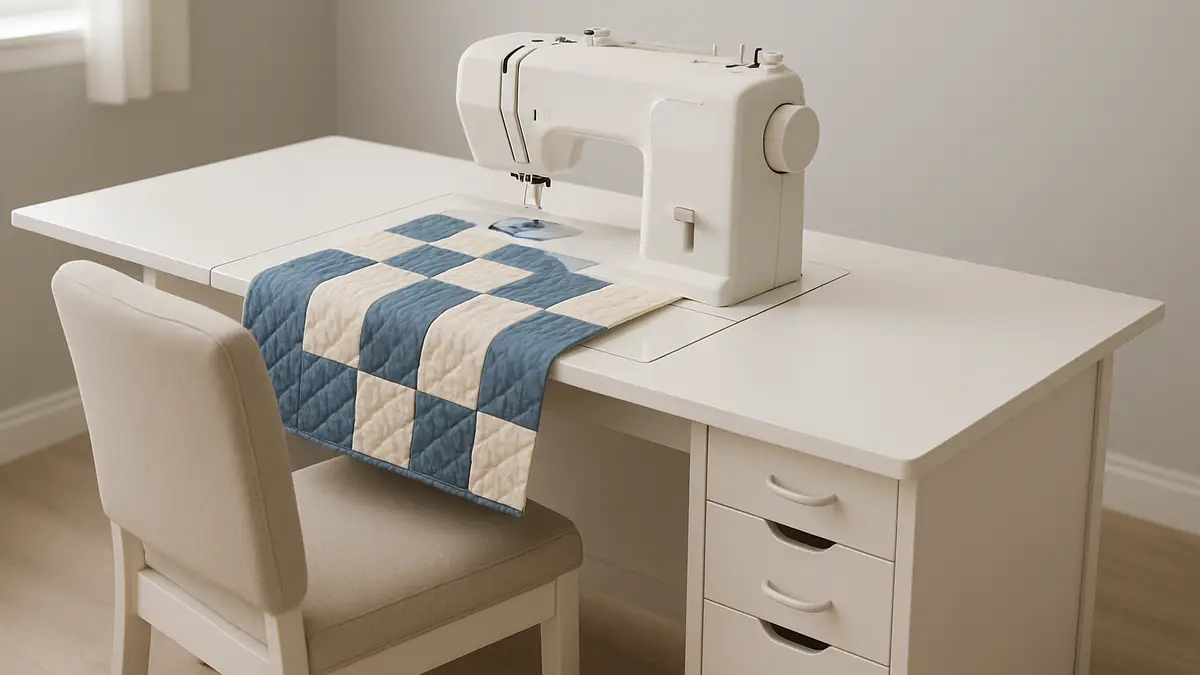
A sewing table does one job a kitchen table cannot: it lowers the machine so its bed sits level with the work surface. That flush surface keeps fabric from dragging off the edge of the machine, which matters most for quilts and long seams. Everything else, from drawers to electric lifts, is comfort and storage on top of that one feature.
What makes a sewing table different from a regular table?
A sewing table has a cut-out or lift platform that drops the machine so its bed is level with the tabletop. On a regular table the machine bed sits several inches above the surface, and the weight of the fabric hanging off that edge pulls the seam off line.
Three other features separate sewing furniture from a desk:
- A rated weight limit for the machine platform, because a heavy machine vibrates at speed and a thin shelf will bounce.
- Leaves or extensions behind and to the left of the needle, where a quilt or a long curtain panel gathers.
- Storage built around sewing: shallow drawers for notions and thread, and sometimes a separate rolling caddy.
If you sew small items on a light machine, a sturdy flat table works. If you quilt, sew curtains or embroider large hoops, the flush surface is the upgrade you notice first.
Which type of sewing table should you buy?
Choose by how often the machine moves and how big your projects are. A folding flush table suits people who sew in a shared room or take classes; a fixed table or a lift cabinet suits a dedicated sewing room.
| Type | How the machine sits | Typical use | Example and US price (Oct 2026) |
|---|---|---|---|
| Folding flush table | Drops into a cut-out, surrounded by an acrylic insert | Small rooms, classes, retreats | SewEzi Portable $349 (insert and carry case included) |
| Folding table with manual lift | 2-position lift: flatbed or free arm | Small rooms, occasional quilting | Arrow Gidget II $425.99 (out of stock on Arrow’s site) |
| Large folding flush table | Cut-out with insert, bigger top | Quilting at home, large machines | SewEzi Grande $619 |
| Height-adjustable table | Electric legs plus a manual lift platform | Sit or stand, sewing and serging | Arrow Eleanor II $1,494.99 |
| Cabinet with manual lift | 2-position lift, leaves fold out | Dedicated sewing room | Arrow Christa $2,199.99 |
| Cabinet with hydraulic or electric lift | 3-position or powered lift, storage caddy | Daily sewing, heavy machines | Arrow Kangaroo and Joey from $3,299.99; Horn electric-lift models through dealers |
Prices are from each maker’s own US store, checked in October 2026. Arrow’s site showed a 20 percent furniture promotion that month, so the price at checkout may be lower.
What does a lift platform do, and which kind do you need?
A lift platform moves the machine up and down inside the cabinet, and the number of positions decides what you can do. A 2-position lift switches between flatbed sewing (machine bed flush with the top) and free-arm sewing (machine raised so you can slide a sleeve or pant leg over the arm). A 3-position lift adds a low storage position so the top closes over the machine.
How the lift moves is a comfort choice:
- Manual lifts need you to raise the machine’s weight by hand. Arrow’s Gidget II and Christa use a 2-position manual lift.
- Hydraulic or air lifts assist the movement. Arrow’s Kangaroo and Joey uses a 3-position hydraulic lift.
- Electric lifts move the machine at the press of a button. Horn of America sells its 5400 and 4200 cabinets with electric lifts through dealers, and Sylvia’s cabinets use a lift it describes as imported from Germany with three adjustable heights.
If you lift a 25 lb machine between positions every day, a powered lift is worth paying for. If the machine stays flush, a fixed cut-out does the same job for less.
How do you check that your machine will fit?
Measure before you order, because a lift opening or a cut-out that is too small cannot be fixed. Three measurements matter: the length and depth of the machine’s bed, the machine’s weight, and the space the machine needs when it is working.
Arrow publishes seven lift opening sizes, from 17-3/4 x 7-1/2 in (A3) to 30-1/2 x 14-1/2 in (A14), and rates the A7 opening for machines up to 55 lb and the A14 for machines up to 65 lb. Individual cabinets carry their own limits: Arrow lists the Gidget II and Christa for machines up to 45 lb, the Eleanor II up to 40 lb and the Kangaroo and Joey up to 55 lb.
Portable tables need the same check. SewEzi recommends its $40 table brace on the Portable table for machines over 13 kg (29 lb), and says it is compulsory with Bernina 7 and 8 Series machines. Your machine’s weight is in its manual or on the maker’s spec page.
Do you need an acrylic insert for a flush surface?
You need one if you want the surface around the machine to be truly flat. A lift or cut-out leaves a gap between the machine and the opening; the insert is a clear acrylic sheet cut to your machine’s bed that fills that gap and supports the fabric right up to the needle.
Inserts are machine-specific. Arrow lists custom inserts from $139 and SewEzi sells laser-cut inserts for $80 to $100, with one included when you buy a SewEzi table (October 2026). If you change machines, budget for a new insert, not a new table. Without an insert, the flush effect is partial: the fabric still dips into the gap on the left and behind the needle.
How much space does a quilter’s sewing table need?
Quilters need table surface behind and to the left of the needle, because that is where the bulk of the quilt sits while you sew. The machine’s throat space decides how much quilt fits under the arm; the table decides how much of the rest is supported instead of hanging and pulling.
Cabinets address this with leaves: Arrow’s Christa has a rear quilt leaf and a side leaf, and the Kangaroo and Joey has collapsible quilt leaves. A folding table can be extended with a second plain table pushed against the back. Our guide to the best sewing machines for quilting covers throat space and extension tables on the machine side.
Once your quilts outgrow a domestic machine on any table, the next step is a frame or a sit-down longarm with its own table, covered in our longarm quilting machine guide.
What does an embroidery machine need from a table?
An embroidery machine needs clear space for the embroidery unit to move, not just a spot for the machine. The carriage moves the hoop to the side and front to back while it stitches, so anything within that reach, including a cabinet wall or a lift opening edge, can stop the hoop and ruin the design.
For single-needle and combo machines, measure the machine with the embroidery unit attached and the largest hoop at full travel, then compare that footprint with the flat area around the opening. Many embroiderers keep the machine on a flat surface rather than in a lift well for this reason. Our combo vs two machines comparison covers the space each setup takes.
Multi-needle machines sit on top of a stand or a heavy-duty surface. Arrow’s Ava embroidery cabinet ($1,999.99 for the Janome and Juki version, October 2026) is built with a heavy-duty top for large multi-needle machines, a thread drawer for 49 spools and shelves for 28 cones. See our multi-needle machine guide for what else those machines need.
How do sewing cabinet brands compare?
The main US sewing furniture makers differ in how they sell more than in what they make. Use this as a map of where to look, then compare specific models by lift type, weight limit and opening size.
| Maker | What it sells | How it sells (Oct 2026) |
|---|---|---|
| Arrow | Folding tables, height-adjustable tables, manual and hydraulic lift cabinets, embroidery cabinets, inserts | Online store with prices; several models out of stock |
| SewEzi | Folding flush tables (Portable, Grande, Grande Traveller), serger table, inserts | US online store with prices |
| Koala | Cabinets with machine lifts, cutting tables, chairs | Own store lists Compact $1,099, Eclipse $1,599, Quilter’s Vision with Companion Chest $1,999, All-In-One Embroidery Studio $2,999, all shown sold out; points buyers to retailers |
| Horn of America | Cabinets including electric-lift models 5400 and 4200, cutting tables, inserts | Dealers only; says its furniture is made in the USA |
| Sylvia | Sewing, quilting and serger cabinets | Lists prices in Canadian dollars on its own site |
Industrial machines are a separate case: they come with their own steel-legged table and motor, so they do not go into a household cabinet. See our industrial sewing machine guide.
How should a sewing table fit your body?
Set the table so your forearms reach the machine bed with your shoulders relaxed and your feet flat on the floor or the pedal. Fixed tables usually sit near ordinary desk height, so the chair does the adjusting. An adjustable sewing chair is often cheaper than an adjustable table and solves the same problem.
Height-adjustable tables help when more than one person sews at the table or when you want to stand for cutting and pressing. Arrow’s Eleanor II adjusts electrically from 28.7 to 48.4 in with four memory settings. Bernina’s adjustable folding table for its Q16 longarm sets to 28, 30 or 32 in, which shows the usual sitting range.
Position matters as much as height: sit centered on the needle, not on the middle of the machine, so you are not twisting to watch the stitch.
Who does not need a sewing table?
Skip the purchase in these cases:
- You sew small projects on a light machine. A compact 4x4 embroidery machine or a light beginner sewing machine works on any sturdy table; the Brother CS7000X from our best sewing machines for beginners list weighs 10.5 lb.
- You sew a few times a year. A $349 to $3,300 piece of furniture is a lot to spend before the hobby sticks.
- You are buying a longarm or an industrial machine. Both come with their own frame or table.
- You move often and the furniture would not. A folding flush table travels; a 3-position cabinet does not.
Sources and price checks (October 2026): Arrow product pages for the Gidget II, Eleanor II, Christa, Kangaroo and Joey and Ava embroidery cabinet, Arrow’s lift-opening size page and custom insert listing; SewEzi US store listings for the Portable, Grande and Grande Traveller tables, inserts and table brace; Koala’s online store; Horn of America’s cabinet range; Sylvia’s product pages; Bernina Q16 adjustable folding table specs from Meissner Sewing.
Frequently asked questions
Quick answers to what readers ask us most
What is the best height for a sewing table?
There is no single correct number because it depends on your chair and your arms. Most fixed tables sit near desk height, and adjustable ones cover a range: Bernina's folding longarm table sets to 28, 30 or 32 in, and Arrow's Eleanor II runs from 28.7 to 48.4 in. Sit so your forearms reach the machine bed without lifting your shoulders.
What does a lift platform in a sewing cabinet do?
A lift platform raises and lowers the machine inside the cabinet. In the low position the machine bed sits flush with the tabletop for flatbed sewing; in the raised position you can use the free arm; in the lowest position some cabinets let you store the machine and close the top. Arrow's Christa has a 2-position manual lift, its Kangaroo and Joey a 3-position hydraulic lift.
Do I need an acrylic insert?
Only if you want a fully flush surface. The insert is cut to your machine's bed and fills the gap between the machine and the edge of the opening. Arrow lists custom inserts from $139, and SewEzi sells machine-specific inserts for $80 to $100 (October 2026), with one included in the price of its tables.
How much weight can a sewing cabinet lift hold?
It depends on the lift. Arrow rates the Gidget II and Christa for machines up to 45 lb, the Kangaroo and Joey up to 55 lb, and its largest A14 lift opening up to 65 lb. SewEzi recommends its table brace for machines over 13 kg (29 lb) on the Portable table. Check your machine's weight in its manual before buying.
Can I use a sewing cabinet with an embroidery machine?
Yes, if the embroidery unit has room to travel. The arm moves the hoop to the side and front to back, so measure the machine with the embroidery unit attached and the hoop at its full reach. Multi-needle machines need a heavy-duty top instead of a lift, such as Arrow's Ava embroidery cabinet.