
Industrial Sewing Machines at Home: Types, Motors, Costs
Should you buy an industrial sewing machine for home? Types, servo vs clutch motors, tables, needles, used-machine checks and October 2026 US prices.
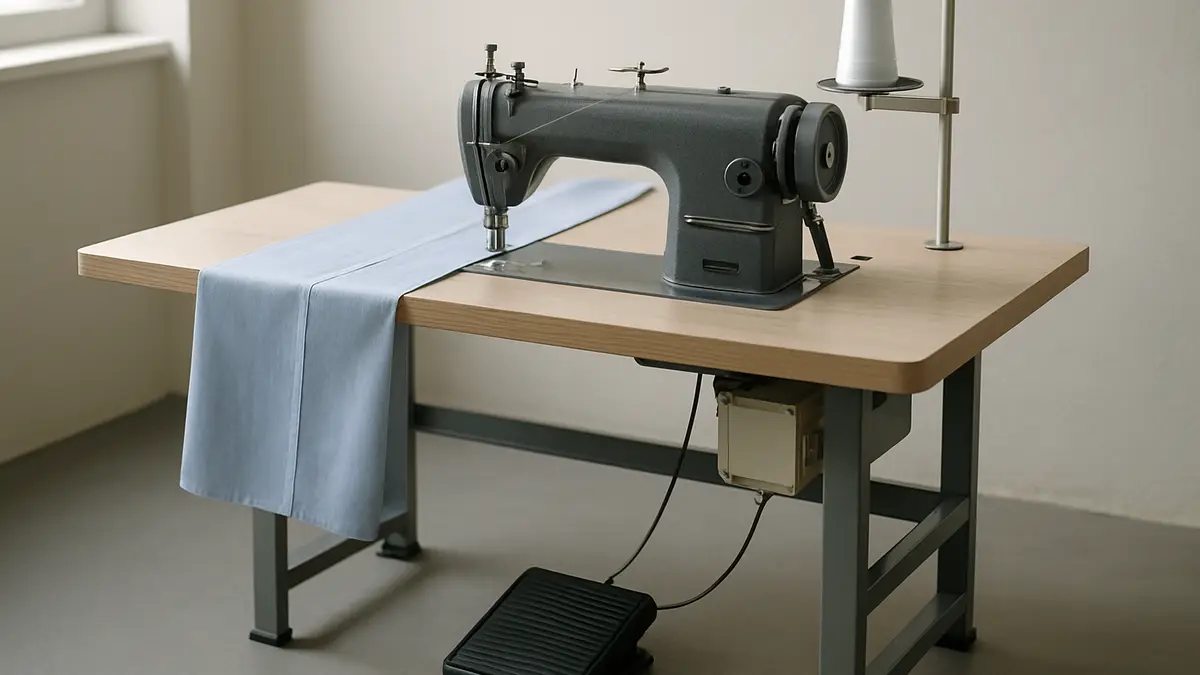
“Industrial” is used loosely in sewing machine marketing. Some listicles call household heavy-duty machines industrial; this page does not. An industrial sewing machine here means a production machine head mounted in its own table with a separate motor underneath, built to sew one stitch type for long hours. The question for a home sewist is whether that trade suits the work you do.
What is an industrial sewing machine?
An industrial sewing machine is a single-purpose machine head that sits in a work table and is driven by a motor mounted under the table. Each model is built around one stitch and one kind of work: a straight lockstitch for garments, a walking foot for upholstery, a cylinder arm for bags and leather, an overlock for seam finishing.
What you gain: speed (the Juki DDL-8700 is rated at 5,500 stitches per minute, against 750 to 850 for most household machines), a steady stitch on long seams, and a heavy head that does not move on the table. What you give up: every extra function. A household machine’s zigzag, buttonholes, decorative stitches and free arm are not part of a straight-stitch industrial machine.
If you want a stronger household machine for denim and canvas, our heavy-duty sewing machine guide is the better starting point.
Which type of industrial sewing machine do you need?
Choose by the material and the seam you sew most. Figures below are from dealer listings that publish the maker’s specs, checked in October 2026.
| Type | What it does | Example | US price, Oct 2026 |
|---|---|---|---|
| Single-needle lockstitch | Straight stitch on light to medium fabric; garments, piecing, home decor | Juki DDL-8700: 5,500 spm, 5 mm max stitch, DBx1 needles | $989 (unassembled table, servo) at Meissner; $1,120 (assembled table, servo) at SewingMachinesPlus |
| Direct-drive lockstitch | Motor in the head, automatic thread trimmer and presser-foot lift | Juki DDL-8000AS-MS: 5,000 spm, 15 mm auto lift | $1,709 at Meissner |
| Walking foot (compound feed) | Feeds thick, layered or slippery material; upholstery, canvas | Juki DU-1181N: 2,000 spm, 9 mm stitch, DPx17; Consew 206RB-5 with 110 V servo | $1,599 (Juki, Meissner); $2,512.06 (Consew, SewingMachinesPlus) |
| Zigzag lockstitch | Straight and zigzag stitch | Consew CN2053R-1 | $1,395.73 at SewingMachinesPlus |
| Cylinder arm | Tubular work: bags, boots, holsters | Techsew 2750 PRO | $3,295; see our leather sewing machine guide |
| Post bed | Raised post for 3D items and curves | Techsew 810 PRO | $2,595 |
| Blindstitch | Invisible hems | Consew CM101 | $2,195.83 at SewingMachinesPlus |
Industrial overlockers and coverstitch machines also exist, on their own tables; for home garment sewing, a household serger is usually the better buy, as our serger vs sewing machine comparison explains.
How does an industrial lockstitch compare with a household straight-stitch machine?
The closest household alternative is a straight-stitch “semi-industrial” machine such as the Juki TL-2010Q, which sews one stitch but runs on household needles and sits on a table like any home machine. For many quilters and garment sewists, it covers the same need with less space.
| Juki DDL-8700 (industrial) | Juki TL-2010Q (household straight stitch) | |
|---|---|---|
| Max speed | 5,500 spm | 1,500 spm, with a slider to cap it from 200 |
| Stitches | Straight stitch only | Straight stitch only |
| Setup | Head in its own table, motor underneath; machine head 28 kg | Portable; sits on a table |
| Needle system | DBx1, sizes 9 to 18 | Household needles |
| Presser-foot lift | 5.5 mm by hand, 13 mm with the knee lifter | Knee lifter included |
| Lubrication | Automatic, from an oil reservoir | Per the manual |
| US price, Oct 2026 | $989 to $1,120 with table and servo | $2,169 suggested retail (Juki America); $1,199 at Meissner |
The TL-2010Q’s speed control and quilting features are covered in our best sewing machines for quilting. Pick the DDL-8700 if you sew long seams for hours, want an unattended production pace and have floor space; pick the household straight-stitch machine if you free-motion quilt or need to carry the machine.
Servo or clutch motor: which should you get?
Get a servo motor. The new home packages we checked all ship with one: the DDL-8700 packages at both Meissner and SewingMachinesPlus include a servo, and Consew sells its 206RB-5 with a 110 V servo.
The difference is how the motor runs. A clutch motor spins continuously from the moment you switch it on and engages through a clutch when you press the pedal, which makes it noisy at rest and hard to hold at slow speed. A servo motor turns only when you press the pedal. Consew’s dealer listing claims its servo is completely silent when the pedal is not pressed, keeps the speed you set no matter how hard you press, uses up to 90 percent less energy than clutch motors and weighs about a third less.
For a beginner on an industrial machine, the adjustable top speed matters most: set it low while you learn, raise it later.
What should you know about power, voltage and motors?
Buy the version built for your outlet. US home packages are sold with 110 to 120 V motors, as the Consew 206RB-5 and Techsew listings state, and plug into a normal household outlet. Motors on used machines from factories may be 220 V or three-phase.
Do not rewire a motor, change a plug or convert voltage yourself. The manual names the motor and power requirements; any change goes to the dealer or a licensed electrician. This guide gives no wiring instructions.
What comes with the table, and what does setup involve?
An industrial machine needs its table: the head drops into a cut-out, the motor hangs underneath, and a belt connects the two. Packages differ in how much is done for you.
- Assembled tables arrive ready, with the head to be fitted. SewingMachinesPlus’s DDL-8700 package lists a fully assembled table and servo motor.
- Unassembled tables cost less but take work. Meissner’s DDL-8700 listing says the customer installs the head into the table, connects the motor belt and belt guard, and assembles the thread stand.
- Freight is separate on most packages; Meissner states freight charges from $150.
Plan for the weight: the DDL-8700 head alone is 28 kg (about 62 lb). An industrial table does not go into a household sewing cabinet; our sewing table guide covers furniture for household machines.
Which needles and how much oil does an industrial machine use?
Industrial machines use their own needle systems, and the system is fixed by the machine. The Juki DDL-8700 takes DBx1 needles in sizes 9 to 18; the Juki DU-1181N walking foot takes DPx17 in sizes 14 to 23; the Consew 206RB-5 takes 135x17. Household machines use 130/705H, which has a flat-sided shank; industrial needles such as DBx1 have round shanks and different dimensions, so the two are not interchangeable. Our needle sizes guide matches sizes to fabric.
Oiling is part of the job. The DDL-8700 has automatic lubrication from an oil reservoir, which still needs the level checked and the oil changed on the schedule in the manual; the DDL-8000AS uses a semi-dry head. Use clear industrial sewing machine oil of the kind the manual specifies. Our sewing machine oil guide covers what to use and why household oils are not substitutes.
What should you check on a used industrial sewing machine?
Used industrial machines are widely sold. Check these before paying:
- Model and needle system. Write down the model from the head and confirm needles and parts are still sold.
- Motor type and voltage. A clutch motor or a 220 V or three-phase motor means extra cost; budget for a 110 V servo installed by the seller or a dealer.
- Sew a test seam in your own fabric. Check stitch balance on top and underneath, and listen for knocking.
- Turn the handwheel by hand. It should turn smoothly without tight spots.
- Look at the oil. The reservoir should hold clean oil, not dark sludge or nothing.
- Table and stand. A wobbling table or a cracked top costs time and money.
- Transport. Plan how to move a heavy head and a table; separate them for the move.
A common model such as the DDL-8700 is the safer used buy because needles, bobbins and parts are widely stocked.
Who should not buy an industrial sewing machine?
- Sewists who need one machine for everything. No zigzag, buttonholes or stretch stitches on a straight-stitch industrial; keep a household machine.
- Free-motion quilters. A longarm or a household straight-stitch machine with a speed slider suits free-motion work better than a 5,500 spm lockstitch.
- Leatherworkers. A lockstitch for garments is the wrong machine for belts and holsters; read our leather sewing machine guide.
- Small spaces and shared rooms. The table, the head weight and the motor make it a permanent fixture.
- Anyone who sews a few hours a month. The speed and durability pay off only with long hours.
Sources and price checks (October 2026): Meissner Sewing listings for the Juki DDL-8700 (unassembled table and servo), DDL-8000AS-MS, DU-1181N and TL-2010Q; SewingMachinesPlus listings for the Juki DDL-8700 (assembled table and servo), Consew 206RB-5, CN2053R-1 and CM101; Techsew product listings for the 2750 PRO and 810 PRO; Juki America suggested retail price for the TL-2010Q as cited in our quilting machine guide.
Frequently asked questions
Quick answers to what readers ask us most
Can I use an industrial sewing machine at home?
Yes. Single-needle lockstitch machines like the Juki DDL-8700 are sold in US packages with a 110 V servo motor and their own table, and they fit in a spare room. Plan for the floor space of a desk, a machine head of about 28 kg (62 lb), and the fact that it sews one straight stitch.
How much does an industrial sewing machine cost?
In October 2026 a Juki DDL-8700 with table and servo motor was $989 at Meissner Sewing (table unassembled, freight from $150) and $1,120 at SewingMachinesPlus (table assembled). Walking-foot machines ran about $1,600 to $2,500, and direct-drive models with automatic thread trimming about $1,700.
What is the difference between a servo and a clutch motor?
A clutch motor spins the whole time it is switched on and engages through a clutch when you press the pedal, so it is loud and hard to control at slow speed. A servo motor runs only when you press the pedal and lets you set a top speed. Consew's dealer listing says its servo is silent at rest and uses up to 90 percent less energy than a clutch motor.
Can an industrial machine sew zigzag or buttonholes?
A straight-stitch lockstitch like the DDL-8700 cannot. Zigzag industrial machines exist, such as the Consew CN2053R-1, and buttonholes are made on dedicated industrial buttonhole machines. That is why most home owners keep a household machine next to the industrial one.
Do industrial machines use the same needles as home machines?
No. Household machines use the 130/705H system with a flat-sided shank; the Juki DDL-8700 uses DBx1, the Juki DU-1181N walking foot uses DPx17 and many upholstery machines use 135x17. The systems are not interchangeable, so buy needles for the system your machine's manual names.