
Machine Embroidery Thread: Polyester vs Rayon and Weights
Which machine embroidery thread to buy: polyester vs rayon, 40 vs 60 weight, bobbin thread, metallics, and what Isacord, Madeira and value brands cost.
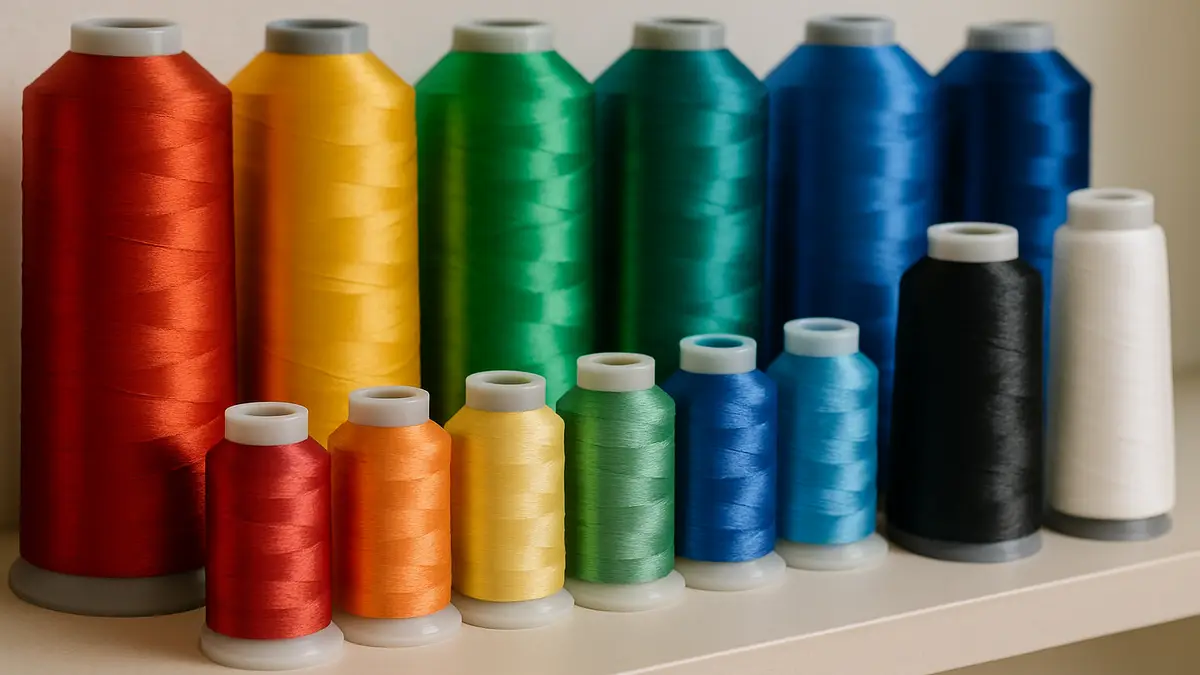
Most thread questions come down to three choices: fiber, weight and brand. The short version is that 40 weight polyester covers nearly every home project, and brand matters less than people expect as long as the thread is made for embroidery. The detail below is for picking the exceptions and for not overpaying.
What thread should you use for machine embroidery?
Use 40 weight polyester embroidery thread as your default. Machine embroidery thread is a smooth, lustrous filament thread made to run at high speed through dense satin and fill stitches, and most commercial designs are digitized for 40 weight. Polyester versions such as Isacord and Madeira Polyneon are strong, colorfast and tolerate frequent washing.
Then add three things: a white and a black bobbin thread, a spool or two of 60 weight for small lettering, and specialty threads only when a project calls for them. A 75/11 embroidery needle is the standard partner for 40 weight thread. Every other choice on this page is an adjustment to that baseline, and our machine embroidery for beginners guide shows how the thread fits into a first stitch-out.
Is polyester or rayon embroidery thread better?
Polyester is the better default; rayon is the better look on items that are washed gently. Rayon (viscose) has a soft, deep sheen and a smooth hand that many embroiderers prefer on heirloom pieces, quilts and decorative items. Polyester is the safer choice for anything washed often, worn hard or bleached.
| Polyester (Isacord, Polyneon) | Rayon (Madeira Classic Rayon, Sulky Rayon) | |
|---|---|---|
| Sheen | High gloss | Soft, deep sheen |
| Strength | Higher; fewer breaks | Good; slightly more breakage at high speed |
| Bleach | Madeira markets Polyneon for chlorine bleach resistance | No bleach claim from Madeira for Classic Rayon |
| Best for | Uniforms, towels, kids’ clothes, caps, anything washed often | Heirloom work, quilts, decorative pieces, gifts |
| US price per 1,000 yd (Oct 2026, cone) | $1.82 (Polyneon 5,500 yd) | $2.42 (Classic Rayon 5,500 yd) |
Both fibers are 40 weight in their standard lines, so you can mix them in one design without re-digitizing.
What do 40 weight and 60 weight mean?
The weight number works backwards: a higher number is a finer thread. 60 weight is thinner than 40 weight, and 30 weight is thicker. Weight numbers are not perfectly standardized between brands, so treat them as classes rather than exact sizes.
| Weight | Use | Needle |
|---|---|---|
| 30 wt | Bolder coverage, decorative work (Madeira lists a #30 rayon) | Larger, often 90/14 (check the thread maker’s chart) |
| 40 wt | The standard; what most designs are digitized for | 75/11 embroidery |
| 60 wt | Lettering under about 1/4 in (6 mm), fine detail | Smaller, often 65/9 or 70/10 (check the thread maker’s chart) |
| 60 or 90 wt bobbin | Bobbin only, usually white or black | Not applicable |
Swapping weights changes coverage. Stitching a 40 weight design in 60 weight leaves gaps in fills; stitching a 60 weight lettering file in 40 weight packs the letters and can cause thread breaks.
Which bobbin thread should you use?
Use a dedicated 60 or 90 weight bobbin thread in white for light fabrics and black for dark ones. Bobbin thread is thinner than top thread so the bobbin holds more and the back of the design stays flat. You do not match bobbin color to each top color. If white bobbin thread shows on the front of a design, top tension is usually too tight; our tension guide shows how to check it.
Two buying options exist. Cones you wind yourself are cheapest: AllStitch listed a 5,500 yd cone of 60 weight polyester bobbin thread at $7.86 in October 2026, about $1.43 per 1,000 yd. Prewound bobbins cost more per yard but save winding time and run longer per bobbin. Prewound bobbins come in classes (sizes), so check the bobbin class in your machine’s manual before buying a box.
How do you sew with metallic and specialty threads?
Slow the machine down and change the needle. Metallic thread is a wrapped foil that frays and twists if it runs fast through a small needle eye. Use an 80/12 or 90/14 metallic or topstitch needle, which has a larger eye, and reduce the machine speed. A vertical spool pin or separate thread stand lets the thread unwind without twisting.
Madeira, for example, sells FS metallics and a polyester-based CR metallic, along with matte, glow-in-the-dark, reflective and flame-resistant lines. Treat each specialty thread as a test-stitch thread: run the design on a scrap of the same fabric and stabilizer first. Matching the stabilizer to the fabric matters as much as the thread; see our embroidery stabilizer guide.
Which embroidery thread brands are worth buying?
Any of the established polyester lines will stitch well; the differences are color range, spool size, where you can buy them and price. These are the brands home and small-business embroiderers in the US meet most often.
| Brand and line | Fiber | Common sizes | Notes |
|---|---|---|---|
| Isacord (Amann) | Polyester | 1,000 m spool, 5,000 m cone | Over 400 colors at isacordthread.com; widely used in US designs’ color sheets |
| Madeira Polyneon | Polyester | 1,100 yd mini cone, 5,500 yd cone | Also 60 and 75 weight lines; easy to find in Europe |
| Madeira Classic Rayon | Rayon | 1,100 yd, 5,500 yd and more | Madeira also lists #30 and #60 rayon |
| Robison-Anton | Polyester and rayon | Spools and cones | Common in US commercial shops |
| Floriani, Sulky | Polyester; Sulky also rayon | Spools | Sold through US sewing and quilt retailers |
| Simthread, ThreadArt | Polyester | 1,000 m spools, sets, 5,000 m cones | Value brands sold online in color kits |
Brother and Janome machines display their own color numbers when they open a design. That does not mean you need Brother or Janome thread; it means you need a conversion, which is what our thread converter does.
How much does machine embroidery thread cost per 1,000 yards?
Between about $1 and $5 per 1,000 yards in October 2026, depending on brand and spool size. Cones cost roughly half as much per yard as small spools of the same thread. These figures come from single listings on the dates checked, so sales move them.
| Thread | Size | Price (Oct 2026) | Per 1,000 yd |
|---|---|---|---|
| Isacord 40 | 1,000 m (1,094 yd) spool | $5.29 sale, $6.49 regular (isacordthread.com) | $4.84 |
| Isacord 40 | 5,000 m (5,468 yd) cone | $13.19 sale, $16.99 regular | $2.41 |
| Madeira Polyneon 40 | 1,100 yd mini cone | $3.59 (AllStitch) | $3.26 |
| Madeira Polyneon 40 | 5,500 yd cone | $9.99 (AllStitch) | $1.82 |
| Madeira Classic Rayon 40 | 1,100 yd mini cone | $4.55 (AllStitch) | $4.14 |
| Madeira Classic Rayon 40 | 5,500 yd cone | $13.29 (AllStitch) | $2.42 |
| ThreadArt polyester | 1,000 m spool | $2.79 sale (ThreadArt) | $2.55 |
| Simthread polyester | 1,000 m spools, 294-color kit | $349 sale for the kit (Simthread) | $1.09 |
Cones need a thread stand on most home machines, since they do not sit on a horizontal spool pin. Small spools fit directly.
How do you match the same color in a different thread brand?
Use a cross-brand converter and then confirm on a color card. Design color sheets name one brand’s numbers, often Isacord, Madeira or the machine’s own palette, and you rarely own that exact brand. Our embroidery thread converter holds 17 thread lines and 4,691 colors from the Ink/Stitch palette files. Type a brand and number and it returns the nearest color in every other line, scored with the CIEDE2000 color-difference formula.
The score bands are the same everywhere on HoopWise: up to 1 is indistinguishable; 1 to 2 is very close, visible only side by side; 2 to 3.5 is close, visible side by side; 3.5 to 5 is noticeable; above 5 is a different color, so check a real color card. The colors are screen values from published palettes, not measurements of real spools, so a physical card is the final check for a customer order.
What should you buy for your first thread kit?
Start with 40 weight polyester in 12 to 20 colors you actually use, plus white and black bobbin thread. Typical first colors: black, white, a warm red, navy, royal blue, kelly green, yellow, orange, pink, purple, brown and a mid gray. A value kit of 40 or 63 colors is fine for learning; replace the colors you run out of with a brand you can buy individually, so you can restock one color at a time.
Store thread away from direct sunlight and dust, and budget thread together with stabilizer and needles when you price a new machine; our embroidery machine buying guide includes those supplies in the first-year cost.
Who is this thread guide not for?
- Hand embroiderers. Stranded cotton floss such as DMC is a different product for needle and hoop work. The converter includes DMC only so a hand pattern’s colors can be moved to machine thread.
- Quilters looking for piecing thread. Cotton or polyester sewing thread for seams is not embroidery thread; our sewing thread guide covers seam thread.
- Shops running multi-head commercial machines. You will buy on cones by the case and should get trade pricing; our multi-needle machine guide covers the machine side.
If you hoop thick items or fight hoop burn, the hoop matters as much as the thread; see magnetic embroidery hoops.
Sources and price checks (October 2026): isacordthread.com 1,000 m and 5,000 m Isacord listings; Madeira USA product pages for Polyneon and Classic Rayon (weights, sizes, bleach statement); AllStitch listings for Madeira cones and mini cones and for bobbin thread; ThreadArt and Simthread product pages. Converter data: Ink/Stitch thread palettes, GPL-3.0.
Frequently asked questions
Quick answers to what readers ask us most
Can I use regular sewing thread for machine embroidery?
It will stitch, but results look dull and dense areas can jam. Embroidery thread is made for sheen and for running fast through satin stitches, and designs are digitized for 40 weight embroidery thread. Keep sewing thread for seams.
Is polyester or rayon embroidery thread better?
Polyester for most people: it is strong, colorfast and stands up to frequent washing, and Madeira markets its Polyneon polyester for chlorine bleach resistance. Rayon has a softer sheen and suits items that are washed gently.
What weight embroidery thread should I use?
40 weight for normal designs, since that is what most files are digitized for. Use 60 weight for small lettering under about 1/4 in (6 mm) tall and for fine detail. Use 60 or 90 weight in the bobbin.
Do I need to buy the same thread brand as my machine?
No. Any quality 40 weight embroidery thread works in any home or commercial embroidery machine. Brother and Janome machines display their own color numbers, and the HoopWise thread converter maps those to the brand you buy.
How do I match a thread color from one brand to another?
Use the HoopWise thread converter: enter the brand and color number and it returns the closest color in 17 thread lines, with a color-difference score that says whether the match is indistinguishable, very close or noticeably different.