
Magnetic Embroidery Hoops: Worth It, and Will They Fit?
Are magnetic embroidery hoops worth it? What they fix, when they slip, which machine families they fit, October 2026 prices, and the makers' safety warnings.
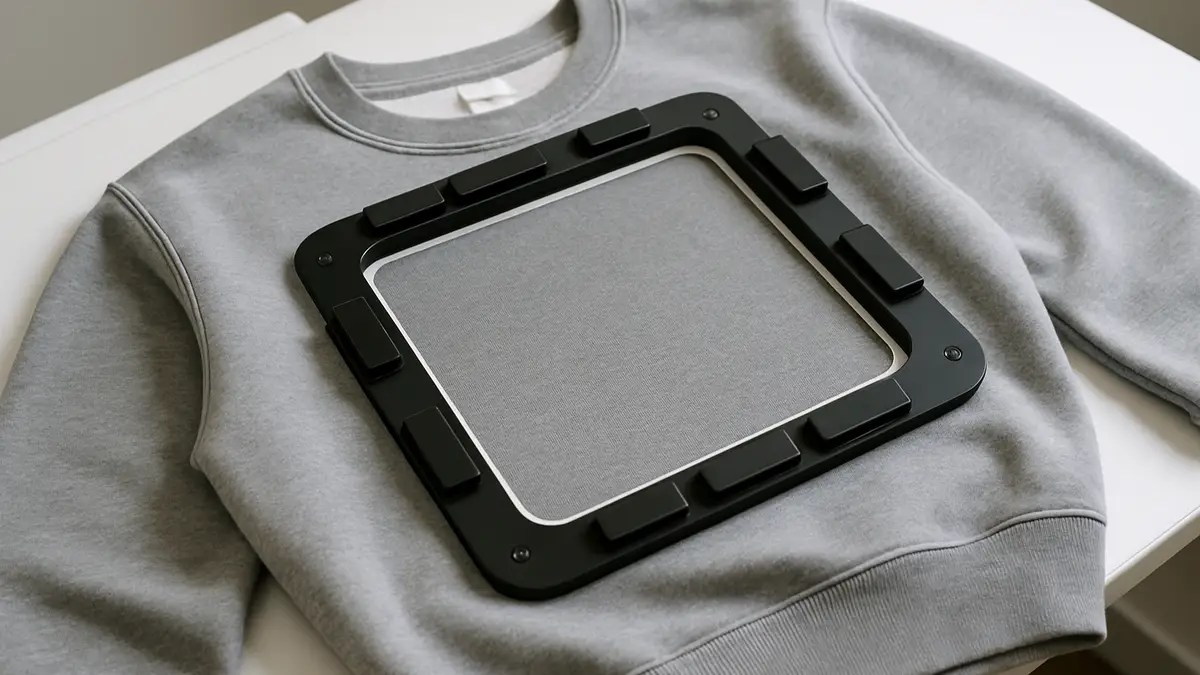
A magnetic hoop replaces the inner ring and tension screw of a standard embroidery hoop with strong magnets that clamp the fabric to a frame. That one change solves several real hooping problems and introduces two new ones: fit and magnet handling. This page covers both, with prices checked in October 2026.
What is a magnetic embroidery hoop?
A magnetic embroidery hoop is a frame that holds fabric and stabilizer by clamping them between a base frame and magnetic bars or a magnetic top ring, instead of squeezing them between an inner and an outer ring tightened with a screw. The magnets are usually neodymium, which is why the hoops grip thick items without adjustment.
The hoop still attaches to the machine the same way a standard hoop does, through a bracket that matches your machine’s embroidery arm. That bracket, not the hoop size, decides whether a magnetic hoop fits. Home versions are often called magnetic sash frames; commercial versions for multi-needle machines clip onto the tubular arm’s hoop arms.
What problems do magnetic hoops solve?
Magnetic hoops solve four problems, and you should buy one only if you have at least one of them:
- Hoop burn. Standard hoops can leave a ring of crushed pile or a shiny mark on velvet, fleece, towels, corduroy and performance knits. Magnets press lightly in spots rather than squeezing a full ring.
- Thick items. Sweatshirts, towels, canvas bags and jackets are hard to force into a screw hoop. Mighty Hoop describes its hoops as adjusting automatically to different thicknesses.
- Hooping time and hand strain. No screw to loosen and retighten per piece; you lay the item down and drop the magnets.
- Re-hooping alignment. Lifting a magnet to nudge fabric is quicker than starting over, which helps when a placement mark has to line up.
Hooping stations that hold the frame in a fixed position, such as the HoopMaster used with Mighty Hoop, add repeatable placement for production runs.
When are magnetic hoops not worth it?
Magnetic hoops are a weaker choice in four situations. Thin, slippery fabrics such as satin and lightweight knits can creep, because magnets clamp in spots rather than all the way around; an adhesive or fusible stabilizer helps, and our embroidery stabilizer guide covers which backing goes with which fabric. Very dense designs on unstable fabric can pull the fabric inward between magnets.
They also cost more. A standard replacement hoop for a home machine is often cheaper than a magnetic set, so if you embroider a few cotton projects a month, the standard hoop that came with your machine is fine. Finally, magnets need careful handling and storage, which matters in a home with children or anyone with an implanted medical device. Read the warnings section below before buying.
Will a magnetic hoop fit your embroidery machine?
It fits only if it is made for your machine’s attachment family. Many models share a family, which is why one listing names several machines. These are examples from October 2026 listings; check the maker’s compatibility list for your exact model number before ordering.
| Machine family (examples) | Machine field | Magnetic option, Oct 2026 |
|---|---|---|
| Brother SE600, SE625, PE535, SE700; Baby Lock Verve | 4x4 in (100 x 100 mm) | MaggieFrame set for this family, single frames from $19.99 |
| Brother PE800, PE770, SE1900, SE2000; Baby Lock Bloom | 5x7 in (130 x 180 mm) | MaggieFrame 4-in-1 set (1 x 2.5, 4x4, 5x7, 5 x 12 in) $149.99; single frames from $19.99 |
| Brother Innov-is NQ1700E, NQ1600E, NQ1400E, Dream Machine 2, VE2200 | Varies by model | MaggieFrame sets from $24.99 |
| Brother Luminaire XP1 to XP3, XV8550D; Baby Lock Solaris, Destiny II, Altair | Large field | MaggieFrame 8x8 in and 8x12 in frames, $68.90 to $69.99 |
| Janome MC500E, MC400E, MC550E; Elna eXpressive 830 | Varies by model | MaggieFrame sets from $53.99 |
| Brother and Baby Lock 6- and 10-needle machines | Commercial frames | Mighty Hoop, $125 to $150 per hoop; 5.5 in starter kit $541 |
| Janome MB-4 and MB-7; Elna 940 and 970 | Commercial frames | Mighty Hoop, $125 to $150 per hoop |
Brother’s PR multi-needle machines take different frames from Brother’s home machines, so a hoop for a PE800 never fits a PR1055X. If you are still choosing a Brother home machine, our Brother embroidery machines compared page lists each model’s field; for commercial machines see the multi-needle embroidery machine guide.
Does a magnetic hoop give you a bigger embroidery area?
No. The maximum embroidery field is set by how far the machine’s arm can move, and no hoop changes it. A 5x7 machine stitches at most 5x7 in, whatever frame is attached. The usable opening of a magnetic frame can even be slightly smaller than the standard hoop’s, because the magnets sit around the edge.
HoopWise uses these field pairs on every page. They describe the stitchable area, not the outer size of the hoop:
| Field (in) | Field (mm) |
|---|---|
| 4x4 | 100 x 100 |
| 5x7 | 130 x 180 |
| 6x10 | 160 x 260 |
| 8x8 | 200 x 200 |
| 8x12 | 200 x 300 |
Some sets include an extra-long frame, such as the 5 x 12 in frame in the PE800-family set above. A longer frame does not turn a 5x7 machine into a 5x12 one; check the hoop maker’s instructions for how your model uses it before counting on it.
How do you avoid hitting a magnet with the needle?
Use your machine’s trace or trial function before every first stitch-out in a magnetic hoop. Tracing moves the hoop around the outline of the design without stitching, so you can see whether the needle path passes close to a magnet. A needle that strikes a magnet breaks, and a hard strike can need a service visit to check the machine.
Three habits prevent most strikes: center the design in the opening rather than at the edge; keep magnets outside the outline with some margin; and recheck after nudging fabric or magnets, since the clamp positions move each time. If a design fills the field edge to edge, a standard hoop may be the safer choice for that design.
What safety warnings do magnetic hoop makers give?
The makers print specific warnings, and you should read them in full before buying. Mighty Hoop’s safety page, published by HoopMaster, warns that fingers can get severely pinched between two attracting hoops, that children should not be allowed to handle the hoops or magnets, that pacemakers can be affected by a strong magnetic force, and that strong magnets can damage magnetic media such as hard drives and credit cards. MaggieFrame’s product page says that people with pacemakers or similar medical implants should avoid handling its hoops.
HoopWise does not add medical advice to these warnings. If you or someone in your home has an implanted device, follow the hoop maker’s instructions and ask the device’s doctor or manufacturer. Store frames with their spacers, away from phones, cards and small children.
Which magnetic hoop brands are worth looking at?
The two brands most often found in US searches cover different machines. MaggieFrame sells magnetic hoops for home machines (Brother, Baby Lock, Janome, Bernina, Pfaff and Husqvarna Viking) and commercial machines (Ricoma, Tajima, Happy Japan, Barudan, SWF, Melco, BAI, ZSK), plus hooping stations: its HoopTalent station with a 6.9 x 6.9 in hoop was $410.91 on sale in October 2026.
Mighty Hoop is made by Midwest Products, Inc. of Germantown, Wisconsin, and sold with the HoopMaster positioning system. It lists hoops for more than 30 machine families, mostly commercial tubular machines from Brother PR to Tajima and Ricoma. Some machine makers also sell their own magnetic frames for selected models, so check your machine’s accessory list too.
Who should not buy a magnetic hoop?
- Occasional embroiderers on stable cotton. The standard hoop does the job; spend the money on thread and stabilizer first, using our machine embroidery thread guide.
- Anyone with an implanted medical device in the household who has not checked the maker’s warning with their doctor.
- Embroiderers who mostly stitch edge-to-edge designs. Magnets around the edge leave less margin; tracing every design becomes mandatory.
- Beginners still learning to hoop. Learning on a standard hoop teaches tension and placement that carry over; see machine embroidery for beginners.
Sources and price checks (October 2026): MaggieFrame domestic machine hoop collection and Brother PE800-family and SE600-family product pages (compatibility, sizes, set price, pacemaker warning); HoopMaster Mighty Hoop pages for Brother PR and Janome machines (prices, kits, maker) and the Mighty Hoops safety warning page.
Frequently asked questions
Quick answers to what readers ask us most
Are magnetic embroidery hoops worth it?
Yes, if you hoop thick items, fabrics that mark easily, or many pieces in a row. For an occasional project on stable cotton, a standard hoop does the job and a magnetic set is a convenience rather than a need.
Do magnetic hoops make the embroidery area bigger?
No. Your machine's maximum embroidery field is fixed by the machine. A magnetic hoop can only use that same field, and its usable opening may be slightly smaller than a standard hoop's because the magnets sit around the edge.
Will a magnetic hoop fit my Brother machine?
It fits if it is made for your machine's attachment family. Brother SE600, SE625, PE535 and SE700 share one family; PE800, PE770, SE1900 and SE2000 share another. Brother PR multi-needle machines use different, commercial-style frames.
Can fabric slip in a magnetic hoop?
Thin, slippery fabrics can creep because magnets clamp in spots rather than gripping all the way around. Use an adhesive or fusible stabilizer, add magnets if the hoop allows it, and keep dense designs on stable fabric.
Are magnetic hoops safe to use?
Follow the maker's warnings. Mighty Hoop warns of severe pinch risk, says children should not handle the hoops, and warns that pacemakers can be affected by strong magnets. MaggieFrame says people with pacemakers or similar implants should avoid handling them.