
Embroidery Stabilizer: Cut-Away, Tear-Away, or Wash-Away
Which embroidery stabilizer to use on knits, wovens, towels, caps, sheers and lace: a fabric-to-stabilizer table plus Sulky and Brother US prices (Oct 2026).
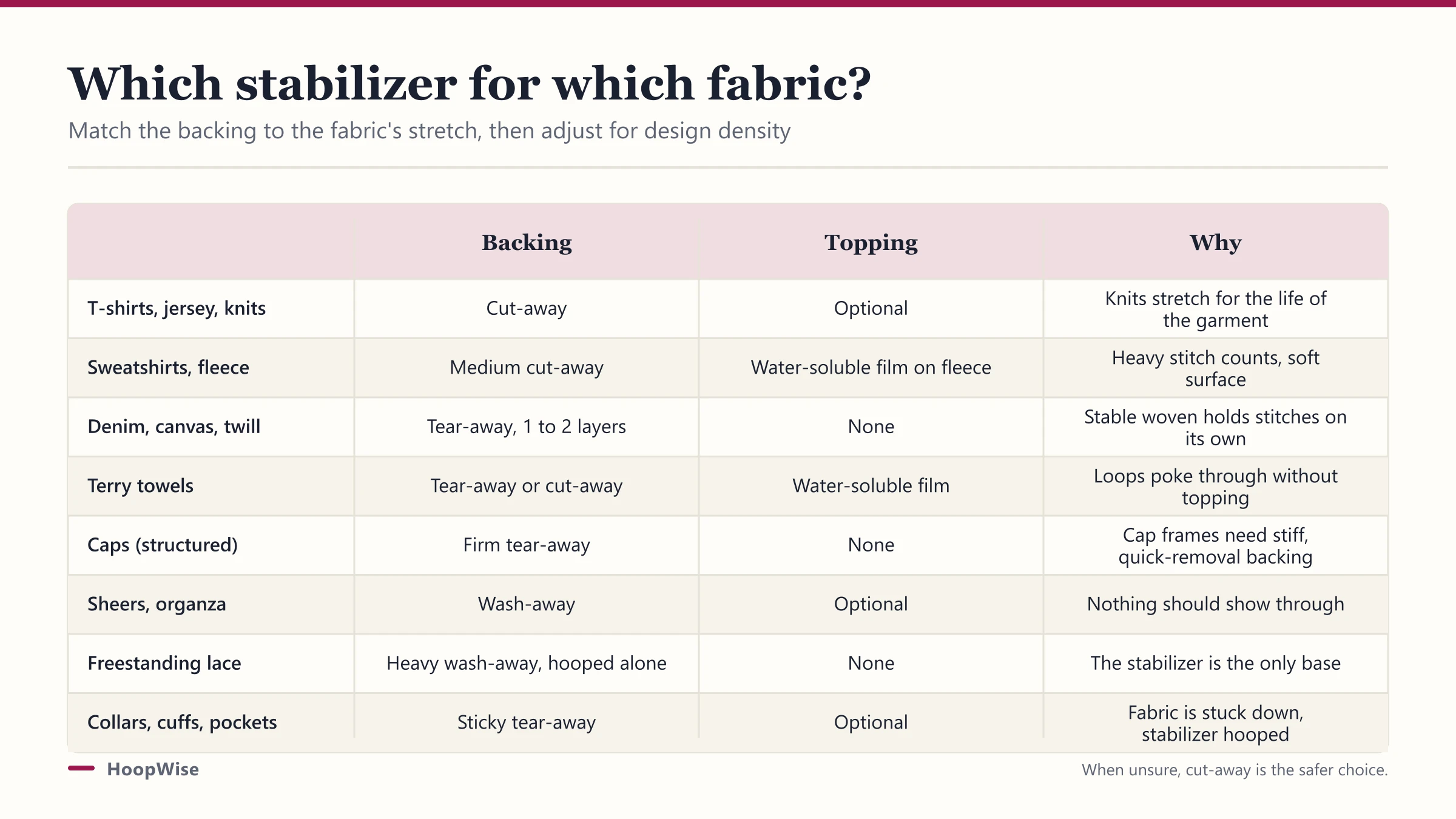
Stabilizer is the part of machine embroidery that beginners skip and then blame on the machine. A dense design puts thousands of needle penetrations into a few square inches; without support, the fabric pulls in, puckers and shifts out of register. The right stabilizer depends almost entirely on whether the fabric stretches.
What does embroidery stabilizer actually do?
Embroidery stabilizer is a non-woven or film material placed under (and sometimes over) the fabric to keep it from stretching, puckering or shifting while the machine stitches. A backing supports the stitches from below; a topping keeps stitches from sinking into piled fabrics. Stabilizers are grouped by how you remove them after stitching: cut-away (stays in the item permanently), tear-away (torn off), wash-away (dissolves in water) and heat-away (removed with a dry iron). Variants add an iron-on (fusible) or self-adhesive (sticky) surface so the fabric holds still without being clamped hard.
Which stabilizer goes with which fabric?
Match the stabilizer to the fabric’s stretch and texture, then adjust for design density. This table is the short version most embroiderers work from, built from the makers’ stated uses quoted later on this page.
| Fabric or item | Backing | Topping | Why |
|---|---|---|---|
| T-shirts, jersey, lightweight knits | Cut-away (no-show mesh or Sulky Soft ‘n Sheer) | Optional | Knits stretch for the life of the garment |
| Sweatshirts, fleece, hoodies | Medium cut-away (Sulky Cut-Away Plus) | Water-soluble film on fleece | Heavy stitch counts, soft surface |
| Polos, pique | Cut-away | Water-soluble film | Textured knit swallows small stitches |
| Denim, canvas, twill | Tear-away (1 to 2 layers) | None | Stable woven holds stitches on its own |
| Quilting cotton, tea towels (flat weave) | Tear-away or light cut-away | None | Stable, but dense designs may need cut-away |
| Terry towels | Tear-away or cut-away | Water-soluble film (Sulky Solvy) | Loops poke through without topping |
| Caps (structured) | Firm tear-away | None | Cap frames need stiff, quick-removal backing |
| Sheers, organza | Wash-away (Sulky Fabri-Solvy or Solvy) | Optional | Nothing should show through |
| Freestanding lace | Heavy wash-away (Sulky Ultra Solvy), hooped alone | None | The stabilizer is the only base and must vanish |
| Items you cannot hoop (collars, cuffs, pockets) | Sticky tear-away (Sulky Sticky+) | Optional | Fabric is stuck down and the stabilizer is hooped |
When should you use cut-away stabilizer?
Use cut-away on anything that stretches and on any design dense enough to need support for the life of the item. Cut-away stays in the garment after you trim the excess, so it keeps holding the stitches through washing and wearing. Sulky describes its Cut-Away Plus as a medium-weight, permanent backing for knits and outerwear such as jackets, sweaters and sweatshirts, and recommends it for dense designs and open-weave fabrics. For lightweight knits where a heavy backing would show, Sulky’s Soft ‘n Sheer is a lightweight nylon cut-away with stretch resistance, and Soft ‘n Sheer Extra is the iron-on version for dense designs. Trim cut-away about 1/4 in from the stitching, never right up to it.
When is tear-away the right choice?
Tear-away is right for stable woven fabrics that do not need support after stitching: denim, canvas, twill, quilting cotton and most home decor fabrics. Brother describes its SA5810 medium-weight tear-away as temporary support for shirts, nylon jackets, blouses, neckties, sheets, pillowcases and ribbons, used alone or layered with a cut-away. Sulky’s Tear-Easy is a lightweight tear-away meant to be used in 1, 2 or 3 layers and torn off one layer at a time so the stitches are not pulled. Its firmer Stiffy is for heavier stitch counts, and Totally Stable is an iron-on tear-away that Sulky positions for knits and stretchy fabrics, a useful exception for projects that will not be worn hard.
What is water-soluble stabilizer used for?
Water-soluble (wash-away) stabilizer is used whenever nothing may remain after stitching: as a topping on towels and fleece, as the only base for freestanding lace, and behind sheer fabrics. It comes in two forms. Clear film, such as Sulky Solvy, Super Solvy (twice as thick) and Ultra Solvy (four times as firm as Solvy), is the standard topping and the lace base. Fabric-like wash-away, such as Sulky Fabri-Solvy, behaves like fabric during stitching and can be hooped alone; Sticky Fabri-Solvy adds an adhesive face.
Sulky states that Solvy dissolves in water from 33 to 200 degrees F. On towels, the topping keeps the loops from poking through satin stitches and keeps small lettering crisp. Heavy wash-away film is also the base for the in-the-hoop method in our embroidered patches how-to.
When do you need heat-away, fusible or sticky stabilizer?
Use heat-away when the fabric cannot get wet and cannot be torn: Sulky’s Heat-Away is a clear film removed with a dry iron, for fabrics that tolerate 260 to 300 degrees F (the cotton setting), and Sulky says not to use it on high-pile fabrics. Use a fusible when the fabric shifts in the hoop or when you want the back of a design covered: Sulky Tender Touch is a lightweight iron-on knit mesh fused over the back of stitches so they do not scratch skin. Use a sticky stabilizer for items that cannot be hooped. Sulky Sticky+ is a self-adhesive tear-away for pockets, cuffs and collars, and Sulky says it avoids hoop marks on fleece, velvet and caps. A magnetic hoop solves the same hoop-burn problem mechanically.
What does stabilizer cost?
Home-size rolls of branded stabilizer run about $8 to $28 in the US, and a 10-yard roll covers dozens of 4x4 in (100 x 100 mm) designs. These are list prices on the makers’ own stores, checked October 6, 2026.
| Product | Type | Roll or pack size | US list price (Oct 2026) |
|---|---|---|---|
| Sulky Cut-Away Plus | Cut-away, medium | 7-2/3 in x 8 yd | $13.49 |
| Sulky Soft ‘n Sheer | Cut-away, lightweight | 8 in x 11 yd | $13.49 |
| Sulky Soft ‘n Sheer Extra | Cut-away, iron-on | 12 in x 9 yd | $27.49 |
| Sulky Tear-Easy | Tear-away, lightweight | 12 in x 11 yd | $15.99 |
| Sulky Stiffy | Tear-away, firm | 8 in x 11 yd | $13.69 |
| Sulky Totally Stable | Tear-away, iron-on | 8 in x 12 yd | $13.79 |
| Sulky Sticky+ | Tear-away, self-adhesive | 8-1/4 in x 6 yd | $20.49 |
| Brother SA5810 | Tear-away, medium | 15 in x 10 yd | $37.99 |
| Sulky Solvy | Wash-away film | 19-1/2 in x 3 yd | $8.49 |
| Sulky Super Solvy | Wash-away film, 2x | 7-7/8 in x 9 yd | $21.49 |
| Sulky Ultra Solvy | Wash-away film, 4x | 7-7/8 in x 8 yd | $25.89 |
| Sulky Fabri-Solvy | Wash-away, fabric-like | 19-1/2 in x 5 yd | $20.89 |
| Sulky Heat-Away | Heat-away film | 7-7/8 in x 9 yd | $13.99 |
| Sulky Tender Touch | Fusible cut-away mesh | 8 in x 9 yd | $15.49 |
Cut the roll width to your hoop: stabilizer should be at least 1 in larger than the hoop on every side so the hoop grips it.
What are the most common stabilizer mistakes?
The most common mistake is using tear-away on a knit, which gives a design that looks fine off the machine and puckers after the first wash. The second is too little stabilizer for the stitch count: a dense, 10,000-stitch fill on a soft fabric needs more support than a light outline, so add a layer or switch to cut-away. The third is hooping the fabric drum-tight and stretched, which locks in distortion that springs back when the hoop comes off. Hoop the stabilizer and fabric together, smooth but not stretched. Thread choice affects puckering too; our machine embroidery thread guide covers weight and bobbin thread.
Who does this guide not cover?
This guide is for home and small-business machine embroidery on single-needle and multi-needle machines. It does not cover hand embroidery, where stabilizer is optional and usually lighter, or industrial production backings bought by the case in commercial weights. Cap embroidery on a multi-needle machine uses cap frames and firm tear-away; the process differs from flat hooping and deserves the machine maker’s own instructions. Our hat embroidery machine guide explains cap frames and drivers. If you are about to stitch your first design, our machine embroidery for beginners walkthrough puts stabilizer in context with hooping, needle and thread, and the thread converter helps when a design’s color list names a thread brand you do not own.
Frequently asked questions
Quick answers to what readers ask us most
Can I use tear-away stabilizer on a T-shirt?
It is not recommended. A T-shirt knit stretches with every wear and wash, and once tear-away is gone nothing holds the stitches, so the design puckers and distorts. Use a cut-away such as no-show mesh or Sulky Soft 'n Sheer, which stays in the garment.
What is the difference between a topping and a backing?
A backing goes under the fabric and supports the stitches. A topping goes on top of textured fabrics like towels, fleece and velvet so the stitches sit on the surface instead of sinking into the pile. Water-soluble film such as Sulky Solvy is the usual topping.
How many layers of stabilizer should I use?
Start with one layer matched to the fabric and add a second when the design is dense or the fabric is soft. Sulky says its Tear-Easy can be used in 1, 2 or 3 layers, torn away one at a time. More layers stiffen the result, so test first.
Does water-soluble stabilizer wash out completely?
Yes, it dissolves in water. Sulky says Solvy dissolves in water from 33 to 200 degrees F. For freestanding lace, rinse until the lace no longer feels stiff, or leave a little in on purpose to keep the lace firm.
Do I need stabilizer with a magnetic hoop?
Yes. A magnetic hoop clamps the fabric without hoop burn, but it does not stop the fabric stretching under the needle. You still choose the stabilizer by fabric type: cut-away for knits, tear-away for stable wovens.