
Hat Embroidery Machines: What It Takes to Embroider Caps
What a hat embroidery machine needs: tubular arm, cap driver, 220 vs 270 degree cap systems, cap field sizes, 2026 prices, and options for single-needle owners.
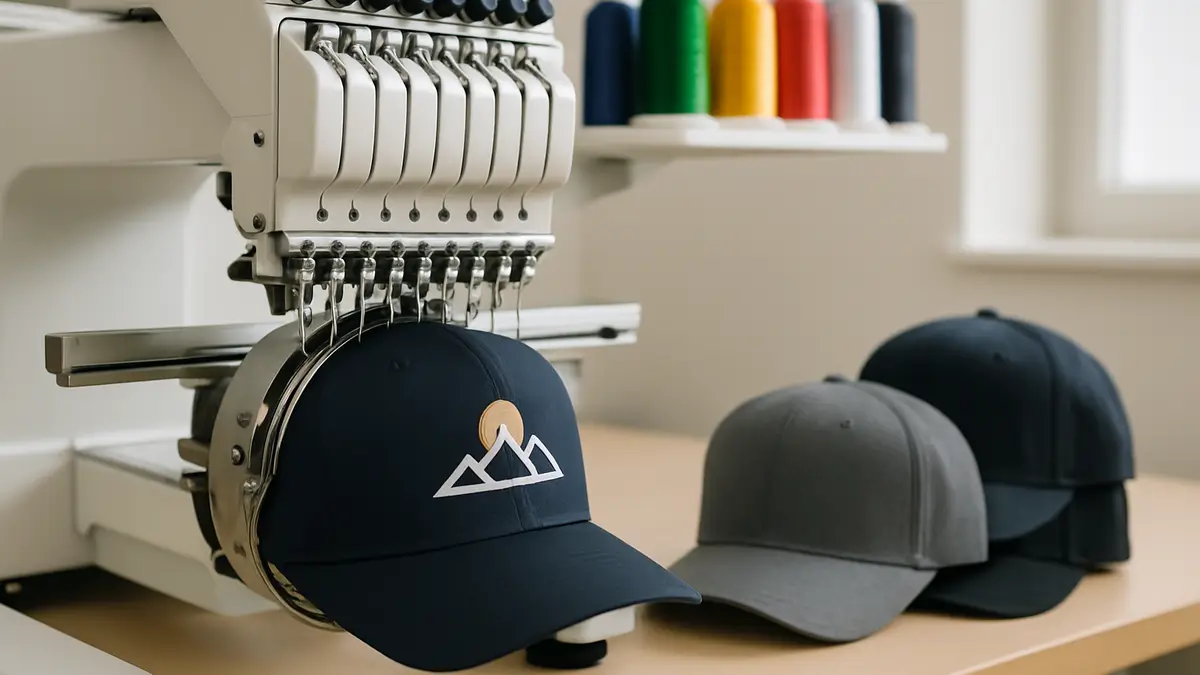
Embroidering a cap is a different job from embroidering a shirt. The cap’s front is curved, often stiff, and attached to a brim that gets in the way, so the machine has to hold the cap in its own shape and turn it under the needle. That takes specific hardware, and the hardware decides which machines can do it.
What makes a machine able to embroider hats?
A machine can embroider finished caps when it has a tubular (cylinder) arm, a cap driver and a cap frame. The cap frame clamps the cap in its curved shape; the driver mounts on the arm and rotates the cap side to side as the design sews, so the needle always meets the fabric at the front of the curve.
Most machines with this setup are multi-needle machines, because their arm is built tubular for sleeves and bags. A few single-needle machines also have a tubular arm and a cap frame option, such as the Brother PRS100. Flatbed home machines, single-needle or combo, do not; the item has to lie flat in the hoop. Our multi-needle machine guide covers the wider upgrade decision; this page covers caps only.
Which caps can you embroider, and which are hard?
Structured caps are the standard for logos and the hardest to hoop; unstructured caps are easier on the cap frame but still need a cap system to be sewn finished.
| Cap type | What it is | What it needs |
|---|---|---|
| Structured | Front panels stiffened with a backing so the crown holds its shape | Cap frame and driver; firm tear-away backing |
| Unstructured | Soft crown that folds flat, often called a dad hat | Cap frame and driver for finished caps; some single-needle cap hoops for soft caps |
| Low profile | Short crown | Less height to stitch; check the field height of your frame |
| Mid and high profile | Taller crown, flatter front on high profile | More room, but the frame and design must match the crown height |
| Flat brim | Straight brim, common on snapbacks | A flat brim frame helps; Brother says its PRCFH5 frame stitches 35 percent closer to the brim (6 to 10 mm, depending on the cap) |
Front construction also matters. A 6-panel cap has a seam down the center of the front, so small text that crosses it can sew unevenly; a 5-panel cap has one wide front panel. Check what your customer wants before digitizing.
Which hat embroidery machines are worth comparing?
These machines are compared here only for their cap systems. For needles, flat field sizes and the single-to-multi-needle decision, see our multi-needle embroidery machine guide. Figures are from the maker’s page or a dealer listing in October 2026.
| Machine | Needles | Cap system (as published) | Cap kit in the price? | US price, Oct 2026 |
|---|---|---|---|---|
| Ricoma EM-1010 | 10 | 220-degree wide-angle cap system | Yes: cap driver and 2 cap rings (Core bundle) | $5,079 Core; $6,879 Ultra |
| Ricoma Creator | 10 | 220-degree system; Ricoma says it stitches 18 mm from the brim | Yes: cap attachments and hooping station | $6,299 Core |
| Ricoma Swift | 15 | 270-degree wide-angle cap system; 1,200 spm | Yes: cap attachments and hooping station | $6,819 Core |
| Brother PRS100 | 1 (tubular arm) | Works with Brother’s PRCF3 cap frame, 130 x 60 mm | No | $4,499.99 at Meissner |
| Brother PR1055X | 10 | Cap frame optional; PRCF5 flat brim cap frame set fits | No | $20,799.99 list (Brother USA) |
| Baby Lock multi-needle machines | 6 to 10 | EPCF4 cap frame 130 x 60 mm; ENCFS wide cap frame 360 x 60 mm on listed models | No | Frames $1,278.99 and $1,589.99 at Meissner |
| Melco Summit | 16 | 14.1 x 3.25 in wide-angle cap frame; up to 1,500 spm | Ask the dealer | Dealer quote |
Two points stand out. Ricoma includes the cap kit in its bundles, while Brother and Baby Lock sell cap frames as accessories costing $1,200 to $2,200. And the cap field height is similar on most standard frames, about 2.4 in (60 mm); wider frames add width around the sides, not height.
What does 220 vs 270 degrees mean on a cap frame?
The degree figure describes how far the cap driver rotates the cap around its front. A wider rotation lets a design run further around toward the sides of the cap in one hooping. A 270-degree system reaches further than a 220-degree system.
For a typical front logo, either is enough: the design sits on the front panels. The wider system matters when customers want text that wraps from the front toward the side, or side and front designs in one run. Ricoma lists 220 degrees for the EM-1010 and Creator and 270 degrees for the Swift. Brother and Baby Lock describe their frames by field size instead; the wide frames (14 in or 360 mm across) are their equivalent of a wrap-around system.
How much do cap frames and drivers cost on their own?
If the machine does not include a cap kit, budget about $1,200 to $2,200 for it. Prices checked in October 2026:
| Cap kit | Field | Price | Source |
|---|---|---|---|
| Brother PRCF3 cap frame and driver set | 5 x 2.4 in (130 x 60 mm) | $1,209.99 | Brother USA |
| Brother wide cap frame and driver set (PR1000 family) | 14 x 2-3/8 in | $2,165.99 | Meissner Sewing |
| Baby Lock EPCF4 cap frame set | 2-3/8 x 5-1/8 in (60 x 130 mm) | $1,278.99 | Meissner Sewing |
| Baby Lock ENCFS wide cap frame set | 14 x 2-3/8 in (360 x 60 mm) | $1,589.99 | Meissner Sewing |
Each kit fits only the machines its maker lists. Brother lists the PRCF3 for the PR1050X, PR650, PR655, PR1000e, PR600II, PR620 and PRS100, among others, and the PRCF5 flat brim set for the PR1055X, PR1000, PR1050X, PR670E and PRS100. Confirm the fit with the dealer before ordering.
How are cap designs digitized differently?
Cap designs are sequenced so the stitching moves from the center of the cap outward and from the brim upward. Because the cap is curved and held only at its edges, sewing one side completely before the other pushes fabric toward the unsewn side and the design ends up off-center or puckered. Starting at the center and working out keeps the push even.
Three practical consequences:
- Do not use a flat design unchanged on a cap. A left-chest logo digitized for a shirt may sew left to right; resequence it or buy the cap version.
- Keep small text and thin lines off the center seam on 6-panel caps.
- Mind the format. Most multi-needle machines read DST, which stores stitches and stops but no thread colors. Our embroidery file formats guide explains what DST does and does not carry.
For backing, use firm tear-away on structured caps, as in the cap row of our embroidery stabilizer guide.
How long does a cap order take on each kind of machine?
In our worked example, a 48-cap order takes about 7.4 hours of machine time on a 10-needle machine with two cap frames, and about 10.5 hours on a single-needle tubular machine. This is arithmetic from stated assumptions, not a timed test, and it is not an income forecast.
Assumptions: a front logo of 6,000 stitches in 4 colors; both machines run caps at 700 spm, a conservative figure below their 1,000 spm rating; loading a cap into the frame and onto the driver takes 1.5 minutes; with a second cap frame, the next cap is loaded while the machine sews, leaving 0.5 minutes to swap; a manual rethread takes 1 minute.
| Step, per cap | 10-needle, one cap frame | 10-needle, two cap frames | Single-needle tubular |
|---|---|---|---|
| Stitching 6,000 stitches at 700 spm | 8.6 min | 8.6 min | 8.6 min |
| 3 color changes | About 0.2 min | About 0.2 min | 3.0 min (manual) |
| Loading the cap | 1.5 min | 0.5 min (swap) | 1.5 min |
| Total per cap | About 10.3 min | About 9.3 min | About 13.1 min |
| 48 caps | About 8.2 hours | About 7.4 hours | About 10.5 hours |
The bigger difference is attention: the single-needle machine needs you at every color change, while the multi-needle machine runs unattended between swaps. Blank caps, thread and backing are extra and depend on your supplier.
What can you do with a single-needle flatbed machine instead?
You have three honest options, none of which sews a finished structured cap:
- Embroider the panels before the cap is assembled. If you sew caps from a pattern, embroider the front panels while they are flat fabric, then assemble the cap.
- Make a patch and attach it. Stitch the design as an embroidered patch, then sew, iron or hook-and-loop it onto the cap. Our embroidered patches how-to covers the steps.
- Use a cap hoop insert for soft caps. Bernina sells the Hoop ‘n’ Buddyz cap hoop insert ($199 at Meissner Sewing, October 2026) for its single-needle embroidery systems; it works with the large oval hoop and holds the cap on adhesive fleece. Bernina’s listing does not say which cap styles it suits; because the front is flattened onto the hoop, expect better results on soft, unstructured caps than on stiff structured ones.
If you mostly want personalized gifts rather than logo caps, a machine chosen for lettering may serve you better; see our monogram machine picks.
Who should not buy a hat embroidery machine?
- You want a few caps for yourself or as gifts. Patches or pre-assembly panels on the machine you own cost nothing extra.
- You have no cap orders yet. A cap-capable machine starts around $4,500; test demand with patches first. This page gives time arithmetic, not an income forecast.
- You need a sewing machine too and have room for one machine. Cap-capable machines are embroidery-only.
- Your caps are mostly unstructured and few. A cap hoop insert, where your machine’s maker sells one, may be enough.
For the overall machine types and price tiers, start with our embroidery machine buying guide.
Sources and price checks (October 2026): Ricoma product pages for the EM-1010, Creator and Swift (cap system angles, bundle contents, prices); Brother USA product pages for the PR1055X, PRCF3, PRCF5 and PRCFH5; Meissner Sewing listings for the Brother PRS100, Brother wide cap frame set, Baby Lock EPCF4 and ENCFS cap frame sets and the Bernina Hoop ‘n’ Buddyz cap hoop insert; Melco’s Summit product page.
Frequently asked questions
Quick answers to what readers ask us most
Can a regular embroidery machine do hats?
Not finished structured caps. A flatbed home machine needs the item lying flat in the hoop, and a structured cap's curved front will not sit flat. You can embroider cap panels before you sew a cap together from a pattern, stitch a patch and attach it, or use a cap hoop insert on some single-needle machines for soft, unstructured caps.
What is the cheapest machine that can embroider hats?
In October 2026 the cheapest cap-capable machines we found were the single-needle Brother PRS100 at $4,499.99 at Meissner Sewing (its cap frame is extra) and the 10-needle Ricoma EM-1010 at $5,079 for the Core bundle, which includes a cap driver and two cap rings.
What is the difference between a 220 and a 270 degree cap system?
The number is how far the cap driver rotates the cap around the front. A 270 degree system lets a design wrap further toward the sides of the cap than a 220 degree system. Ricoma lists 220 degrees for its EM-1010 and Creator and 270 degrees for its Swift.
How big can a design on a hat be?
On standard cap frames the field is about 2.4 in (60 mm) tall: Brother's PRCF3 frame stitches 5 x 2.4 in (130 x 60 mm). Wide cap frames keep the height but add width, such as 14 x 2-3/8 in (360 x 60 mm) on Baby Lock's wide cap frame set. Melco lists a 14.1 x 3.25 in wide-angle cap frame for its Summit.
What stabilizer do you use for embroidering caps?
A firm tear-away backing is the usual choice for structured caps, because cap frames need stiff backing that is quick to remove. Unstructured caps behave more like soft fabric and need the backing your stabilizer chart gives for the cap's material.