
Multi-Needle Embroidery Machines: When to Upgrade
When a multi-needle embroidery machine makes sense: needles, field sizes, cap frames, October 2026 US prices, and the time math for a 100-shirt order.
A multi-needle machine buys you time, not better stitches. The stitch quality of a good single-needle home machine and a multi-needle machine is close on a flat item; what changes is how often you have to stand at the machine and what shapes you can hoop. This page covers when that trade is worth several thousand dollars.
When should you upgrade from a single-needle to a multi-needle machine?
Upgrade when thread changes and hooping, not stitching, are what limit your output. A single-needle home machine stops at every color and waits for you to rethread, so a six-color logo needs you at the machine five more times after you press start. A multi-needle machine loads all six colors at once and runs the design unattended.
Four signals point to the upgrade:
- You sell the same design in runs of a dozen pieces or more.
- Customers ask for caps, which a flatbed single-needle machine cannot sew once the cap is finished.
- You spend more time rethreading than hooping.
- You want to hoop the next item while the machine is still sewing.
If none of those apply, the single-needle tiers in our embroidery machine buying guide cost a fraction as much and do the same job on flat items.
What does a multi-needle embroidery machine do differently?
A multi-needle embroidery machine is an embroidery-only machine with a row of needles, each threaded with its own color, that switches between them automatically. Three practical differences follow.
First, the needle case moves instead of you rethreading, so color changes take seconds. Second, the arm is tubular rather than a flat bed: sleeves, bag fronts, pant legs and, with a cap driver, caps slide over it. Third, these machines are built for long runs. The models below are rated at 800 to 1,000 stitches per minute (spm), while home single-needle machines are typically rated around 400 to 850 spm.
What they do not do: sew seams. A multi-needle machine is embroidery only, so you still need a sewing machine for construction.
Which multi-needle machines are worth shortlisting in 2026?
These are the home-business machines most often compared in the US, with the numbers from each maker’s own product page, checked in October 2026. Field sizes are the maximum stitchable area, not the outer hoop size.
| Machine | Needles | Max field (as published) | Rated speed | US price, Oct 2026 | Notes |
|---|---|---|---|---|---|
| Ricoma EM-1010 | 10 | 12.2 x 8.3 in (310 x 211 mm) | 1,000 spm | From $5,079 (Core bundle); $6,879 (Ultra bundle) | Cap driver and 2 cap rings included; DST |
| Ricoma Creator | 10 | 15 x 8.3 in (380 x 210 mm) | 1,000 spm | $6,299 (Core bundle, listed down from $7,999) | 220-degree cap system included; DST |
| Janome MB-7 | 7 | 240 x 200 mm (9.4 x 7.9 in) | 800 spm | About $6,000 at US dealers | Smallest footprint in this list |
| Brother PR680W | 6 | 8 x 12 in | 1,000 spm | Dealer price only (not listed on Brother USA) | Wireless; cap frame capable |
| Baby Lock Array | 6 | 7-7/8 x 11-3/4 in (200 x 298 mm) | 1,000 spm | $14,574 list, $13,249 special price (Baby Lock, Nov 2026) | 4 hoops included |
| Brother PR1055X | 10 | 8 x 14 in | 1,000 spm | $20,799.99 list (Brother USA) | Wireless; links up to 10 machines; cap frame optional |
Brother and Baby Lock sell through authorized dealers, who often bundle hoops, software and training, so the price you pay can differ from the list figure. Ask every dealer for the same bundle in writing before comparing.
Is a bigger embroidery field the same as more needles?
No. Field size and needle count are separate decisions, and two machines prove it. The Baby Lock Meridian 2 is a single-needle machine with a 9.5 x 14 in field, a rated 1,050 spm and a $9,349 price on Baby Lock’s site. The Brother Entrepreneur One PR1X is also single-needle, with an 8 x 12 in field, yet Brother markets it to small businesses.
A large-field single-needle machine suits big one- or two-color work: quilt blocks, jacket backs, large appliqué. A multi-needle machine suits many colors on many garments, even when each design is small. If your typical order is a 4 in wide left-chest logo in five colors, needles matter more than field. If it is a 12 in jacket back in one color, field matters more than needles.
How much time does a multi-needle machine save on 100 shirts?
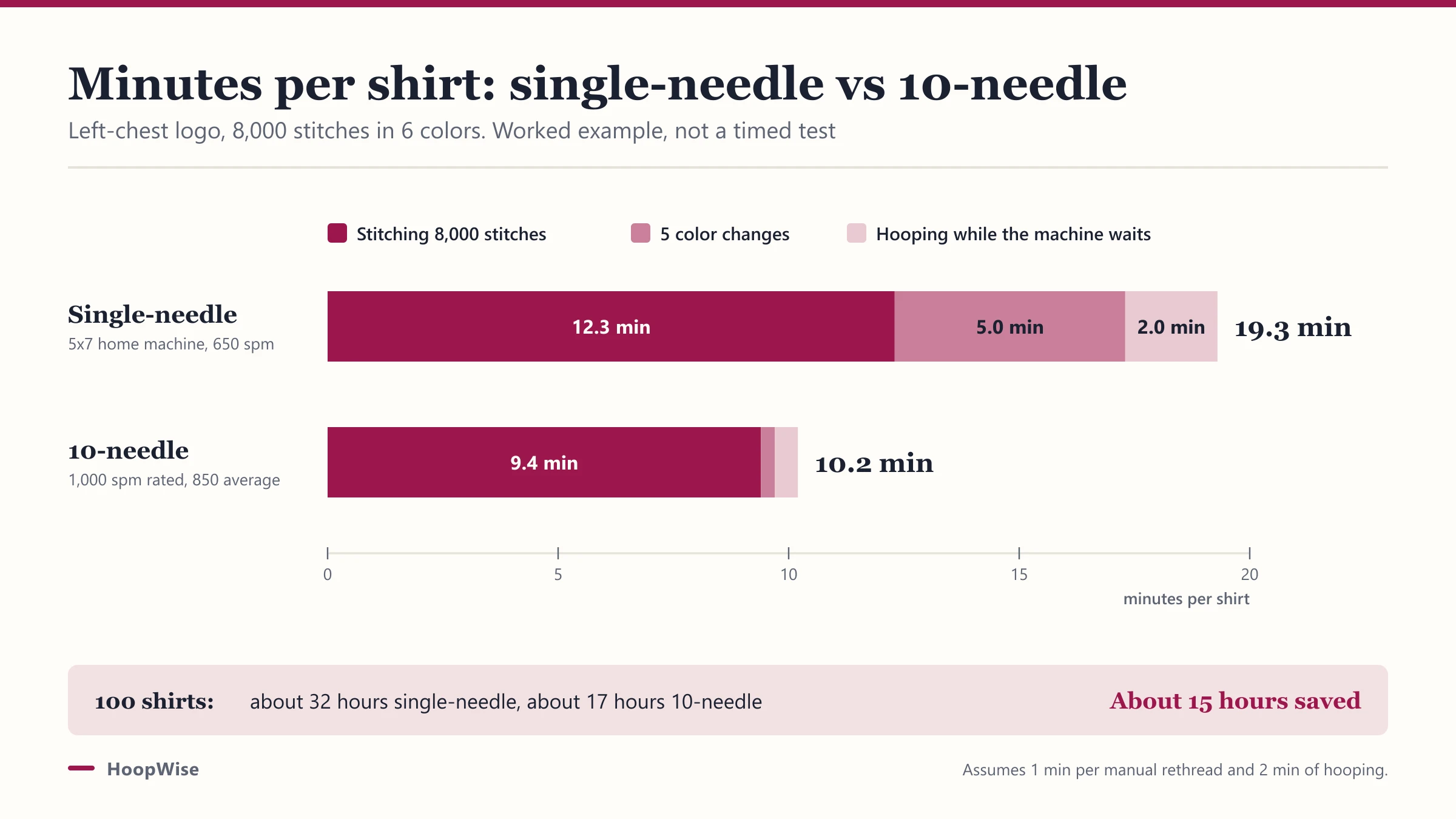
In our worked example, about 15 hours: roughly 32 hours of machine time on a single-needle home machine against 17 on a 10-needle machine. This is arithmetic from stated assumptions, not a timed test. The assumptions: a left-chest logo of 8,000 stitches in 6 colors; the single-needle machine runs at 650 spm, mid-range for home machines; the multi-needle machine is rated 1,000 spm but averages 850 once trims and slowdowns are counted; a manual rethread takes 1 minute; hooping takes 2 minutes.
| Step, per shirt | Single-needle 5x7 home machine | 10-needle machine |
|---|---|---|
| Stitching 8,000 stitches | 12.3 min (at 650 spm) | 9.4 min (850 spm average) |
| 5 color changes | 5.0 min (manual rethreads) | About 0.3 min (automatic) |
| Hooping while the machine waits | 2.0 min | 0.5 min (next shirt hooped during the run) |
| Total per shirt | About 19.3 min | About 10.2 min |
| 100 shirts | About 32 hours | About 17 hours |
The table understates one difference. On the single-needle machine you must be present every two to three minutes for a rethread; on the multi-needle machine those 17 hours are mostly unattended, so you can hoop, fold and pack at the same time. Swap in your own stitch counts and speeds: the gap grows with more colors and shrinks with one-color designs.
What does a multi-needle machine cost beyond the sticker price?
Budget for five things the base price may not cover:
- Cap frame and driver. Ricoma’s bundles include them; for the Brother PR1055X the cap frame is an optional accessory. Our hat embroidery machine guide prices cap frames and drivers on their own.
- Magnetic hoops. Mighty Hoop magnetic frames for Brother and Baby Lock 6- and 10-needle machines run $125 to $150 each, and the 5.5 in starter kit is $541 (HoopMaster, October 2026). Our magnetic embroidery hoops guide covers whether they are worth it.
- Thread on cones. A 5,500 yd cone of Madeira Polyneon 40 was $9.99 at AllStitch in October 2026; filling 10 needles with your core colors is a few hundred dollars once you add specialty shades.
- Software. Lettering and editing on a computer usually means paid software; see embroidery software compared.
- Space and upkeep. These machines need a sturdy stand, room for the thread tree, and routine oiling and cleaning on the schedule in the manual.
Which file formats and thread colors does a multi-needle machine use?
Most commercial-style machines are built around DST, the Tajima format, and Ricoma lists DST for both machines above. Brother PR models also read Brother’s own PES format. Our embroidery file formats guide explains which machine reads what and why converting between formats needs care.
DST stores stitches and stop points but no thread colors, so on a multi-needle machine you map each stop to a needle yourself. That is where brand mixing happens: a design sheet may call for Isacord numbers while your needles hold Madeira. The thread converter finds the nearest color in 17 thread lines and scores how close the match is, so you can decide whether the shade on needle 4 is close enough or worth a new cone.
Who should not buy a multi-needle embroidery machine?
Skip the upgrade if any of these describe you:
- You embroider for yourself and as gifts. A single-needle machine at $300 to $1,500 does the same flat work; start with our best embroidery machines for beginners.
- Your designs are mostly one or two colors. The time saving comes from color changes; with few colors it shrinks toward the speed difference alone.
- You need a sewing machine too and have room for one machine. Multi-needle machines do not sew seams.
- You have not sold anything yet. Test demand on the machine you own before spending $5,000 or more; this page gives time arithmetic, not an income forecast.
Sources and price checks (October 2026): Ricoma product pages for the EM-1010 and Creator; Brother USA product pages for the PR1055X, PR680W and PR1X; Baby Lock product pages for the Array and Meridian 2; HoopMaster’s Mighty Hoop listings for Brother PR machines; AllStitch for Madeira Polyneon cone prices. The Janome MB-7 figures are from Janome’s published specifications and US dealer listings; confirm the price with a dealer.
Frequently asked questions
Quick answers to what readers ask us most
How much does a multi-needle embroidery machine cost?
In October 2026 the home-business tier starts around $5,000 (Ricoma EM-1010 Core bundle from $5,079) and runs past $20,000 (Brother PR1055X lists at $20,799.99 at Brother USA). Six-needle models sit in between, and dealer bundles change the real price.
Is a multi-needle embroidery machine good for beginners?
A beginner can learn one, but it is rarely the right first machine. You pay thousands for speed and cap capability that only matter once you run repeat orders. Most people start on a single-needle machine and upgrade when thread changes become the bottleneck.
Can a single-needle embroidery machine sew hats?
Not finished structured caps. A flatbed single-needle machine needs the item lying flat in the hoop. Multi-needle machines sew caps with a cap frame and cap driver that fit their tubular arm.
How many needles do I need?
Six covers most logos, since few use more than six colors. Ten or more lets you keep common colors such as black, white and navy loaded while you run different jobs back to back, which saves rethreading.
What file format do multi-needle machines read?
DST is the common commercial format, and Ricoma lists DST for its EM-1010 and Creator. DST stores stitches and color-change stops but no thread colors, so you assign the colors at the machine.