
Embroidery Thread Conversion Chart: Match Any Brand
How an embroidery thread conversion chart works, why cross-brand matches are approximate, which brands use which number systems, and how to score a match.
A design file names colors in one brand’s numbers, and you almost never own that brand. A conversion chart bridges the gap, but it is a shortlist, not a guarantee. The sections below show how the number systems differ, how to read a chart, and how to tell a safe match from one that needs a physical card.
What is an embroidery thread conversion chart?
An embroidery thread conversion chart is a table that maps a color number in one thread brand to the nearest color number in another. You read across a row: the source brand and number on the left, the closest equivalents in other brands across the columns. Design color sheets usually name one brand, often Isacord, Madeira or the machine’s own palette, so the chart tells you what to load from the spools you actually have.
Charts save time, but they do not make two brands identical. Each maker mixes its own dyes, so the nearest match is still a different physical thread. For most home projects that is fine. For a customer logo with a fixed brand color, the chart narrows the choice and a real color card makes the final call.
Why can you not convert thread colors exactly?
Because every brand dyes to its own palette, and no two palettes line up. A conversion is a nearest-neighbor guess, not an equals sign. Three things pull matches apart:
- Different dye recipes. Isacord, Madeira and Robison-Anton each formulate their own colors, so the closest number in another line is usually a shade off.
- Screen values, not spools. Digital charts compare published color codes on a screen, not light measured off the real thread, so gloss and fiber are ignored.
- Palette gaps. A line with 400 colors cannot match every color in a line with 1,000; sometimes the nearest match is clearly off.
This is why two charts from two retailers often name different equivalents for the same source color. Neither is wrong; they drew the line between two close candidates differently.
Which brands use which number systems?
Each major brand numbers its colors its own way, which is why a raw number means nothing without the brand. These are the systems you meet most often in US and European designs.
| Brand and line | Number style | Notes |
|---|---|---|
| Isacord (Amann) | Four digits, such as 0015 or 0020 | Over 400 polyester colors; named on many US design color sheets |
| Madeira Polyneon | Mostly 1600 to 1900 range | Polyester; Madeira also runs Rayon and Frosted Matt lines with their own numbers |
| Madeira Classic Rayon | 1000 and 1100 ranges | Rayon; a different sheet from Polyneon even for the same shade |
| Robison-Anton | 2000s (polyester) and separate rayon numbers | Common in US commercial shops |
| Brother and Janome palettes | Color names plus the maker’s own numbers | Shown on screen when a PES or JEF design opens |
| Gunold, Floriani, Sulky | Each its own numbering | Sold through US quilt and embroidery retailers |
Write down the brand as well as the number every time, or a conversion is impossible.
How do you read a thread conversion chart?
Find the source color in the column for the brand the design names, then read across to the brand you own. Work in this order:
- Identify the source. The design color sheet names a brand and number, for example Isacord 0015.
- Pick your target brand. The thread you own and can restock one color at a time.
- Read across the row to the target column for the suggested number.
- Check the score if the chart gives one, or compare the two on screen.
- Confirm on a card for anything that has to match a logo.
For whites, blacks and bold primaries this is quick and reliable. For muted grays, teals and browns, expect to choose between two or three near candidates, which is where a color-difference score earns its place. Our machine embroidery thread guide covers which of these brands to actually stock.
How accurate is a digital conversion?
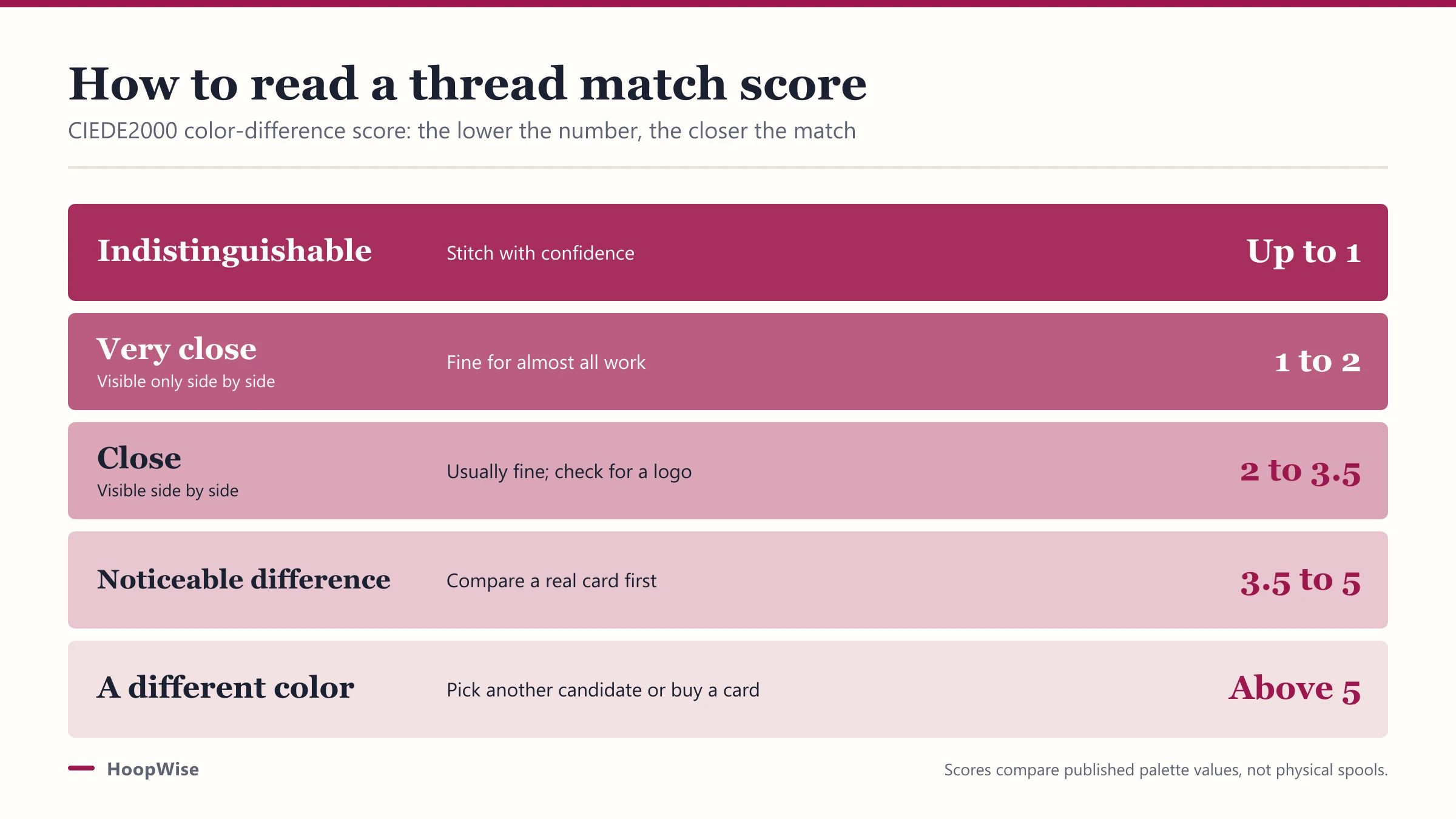
Accurate enough to stitch from for some colors, and clearly flagged when it is not, if the chart reports a color-difference score. Across the 17 lines in our converter, about 29% of line-to-line matches score 3.5 or below, so expect to check many picks. The HoopWise converter scores every match with the CIEDE2000 formula, the current industry standard for how far apart two colors look to the eye.
| Score (CIEDE2000) | Meaning | What to do |
|---|---|---|
| Up to 1 | Indistinguishable | Stitch with confidence |
| 1 to 2 | Very close, visible only side by side | Fine for almost all work |
| 2 to 3.5 | Close, visible side by side | Usually fine; check for a logo |
| 3.5 to 5 | Noticeable difference | Compare a real card first |
| Above 5 | A different color | Pick another candidate or buy a card |
A single number turns a vague chart into a decision. The colors behind the score are published palette values, not measurements of physical spools, so a real card is still the final check for a paid order.
When should you buy a physical color card instead?
Buy a brand color card when the color is part of a paid brief, when the shade is a muted mid-tone, or when the converter score sits above about 3.5. Color cards show the real stitched thread under real light, which is the only honest way to approve a logo color.
A card also pays off if you buy one brand in bulk and convert everyone else’s sheets to it. Order the card for your main brand, keep it by the machine, and use the chart to get close before you confirm against the card. For hand-embroidery floss such as DMC moving to machine thread, the same rule applies: convert, then check a card.
Which brands can the HoopWise converter match?
The converter holds 17 thread lines and 4,691 colors drawn from the Ink/Stitch palette files, including Isacord, Madeira Polyneon and Rayon, Robison-Anton, Brother, Sulky, Gunold and more. Enter a brand and color number, and it returns the nearest color in every other line, each scored with CIEDE2000, sorted closest first.
That covers the conversion most design sheets need, plus the cross-reference to the machine’s own palette. Use the HoopWise thread converter for the match, this chart logic to read the result, and a color card for anything that has to be exact. For seam thread rather than embroidery thread, see the sewing thread guide.
How do a machine’s on-screen colors relate to the thread you buy?
The colors a machine shows on screen are its own palette, not an instruction to buy that brand. When a Brother or Janome machine opens a design, it displays color names or numbers from its built-in palette so you can follow the sequence, but you load whatever thread you own for each stop.
This trips up new owners who think they must buy the machine brand’s thread. You do not. Treat the on-screen color as one more source to convert: note the machine palette name, find its nearest match in your thread brand with the converter, and load that. The machine only cares that you change thread at each color stop, not which brand sits on the spool pin. The same applies to designs sold with a color sheet in a brand you do not stock.
How do you convert a whole design’s color list?
Work down the design’s color sequence one stop at a time, converting each named color to your brand and writing the result on a thread card. A design with twelve colors has twelve conversions, and doing them before you start saves stopping mid-project to hunt for a match.
List the design’s colors in order, run each through the HoopWise thread converter, and note the nearest number in your brand plus its score. Flag any color scoring above about 3.5 to check against a physical card. Then pull and line up the spools in stitch order before the first stitch, so each color change is just reaching for the next spool. For designs with custom lettering in a brand palette, the embroidery fonts guide covers how color stops and lettering interact.
Who does not need a conversion chart?
- Embroiderers who pick colors by eye. If you choose your own palette, the design’s named brand does not matter.
- Anyone stitching a single brand end to end. Buy the design in your brand’s colors if the shop offers it.
- Hand embroiderers staying in floss. DMC and Anchor have their own long-standing cross-reference; the machine-thread chart is only for moving floss colors to machine thread.
For how color numbers travel inside the design file itself, see our embroidery file formats guide.
Sources: Isacord (isacordthread.com) color listings; Madeira USA Polyneon and Classic Rayon pages; Robison-Anton color references; Brother and Janome on-screen palettes; Ink/Stitch thread palette files (GPL-3.0), which supply the converter’s 17 lines and 4,691 colors; CIEDE2000 color-difference formula (CIE).
Frequently asked questions
Quick answers to what readers ask us most
Is there one official embroidery thread conversion chart?
No. Thread makers do not publish a single agreed cross-reference, because each dyes to its own palette. Retailers and software makers build their own charts, and they disagree on borderline colors. Always treat a charted match as a candidate and confirm it on a real color card.
How accurate are thread conversion charts?
Accurate for strong, common colors like white, black and primary reds, and less reliable for muted mid-tones, grays and metallics. A digital match is a screen value, not a measurement of the real spool, so two charts can name different numbers for the same source color.
What does the color-difference score mean?
It is a CIEDE2000 number. On HoopWise, up to 1 is indistinguishable, 1 to 2 is very close, 2 to 3.5 is close, 3.5 to 5 is noticeable and above 5 is a different color. Use the score to decide whether to trust the chart or buy a card.
Can I convert Brother machine colors to Madeira or Isacord?
Yes. Brother and Janome machines display their own color names when a design opens, but you can stitch any brand. Enter the source color in the HoopWise converter and it returns the nearest Madeira, Isacord, Robison-Anton and other matches with a score for each.
Do I need to convert thread colors at all?
Only when a design's color sheet names a brand you do not own. Many embroiderers pick their own colors by eye and ignore the sheet. Conversion matters most for logos and licensed designs where the exact shade is part of the brief.