
Embroidery Hoop Sizes: Chart in Inches and mm
Embroidery machine hoop sizes explained: 4x4, 5x7 and larger in inches and mm, why the usable field is smaller than the hoop, and which size to use.
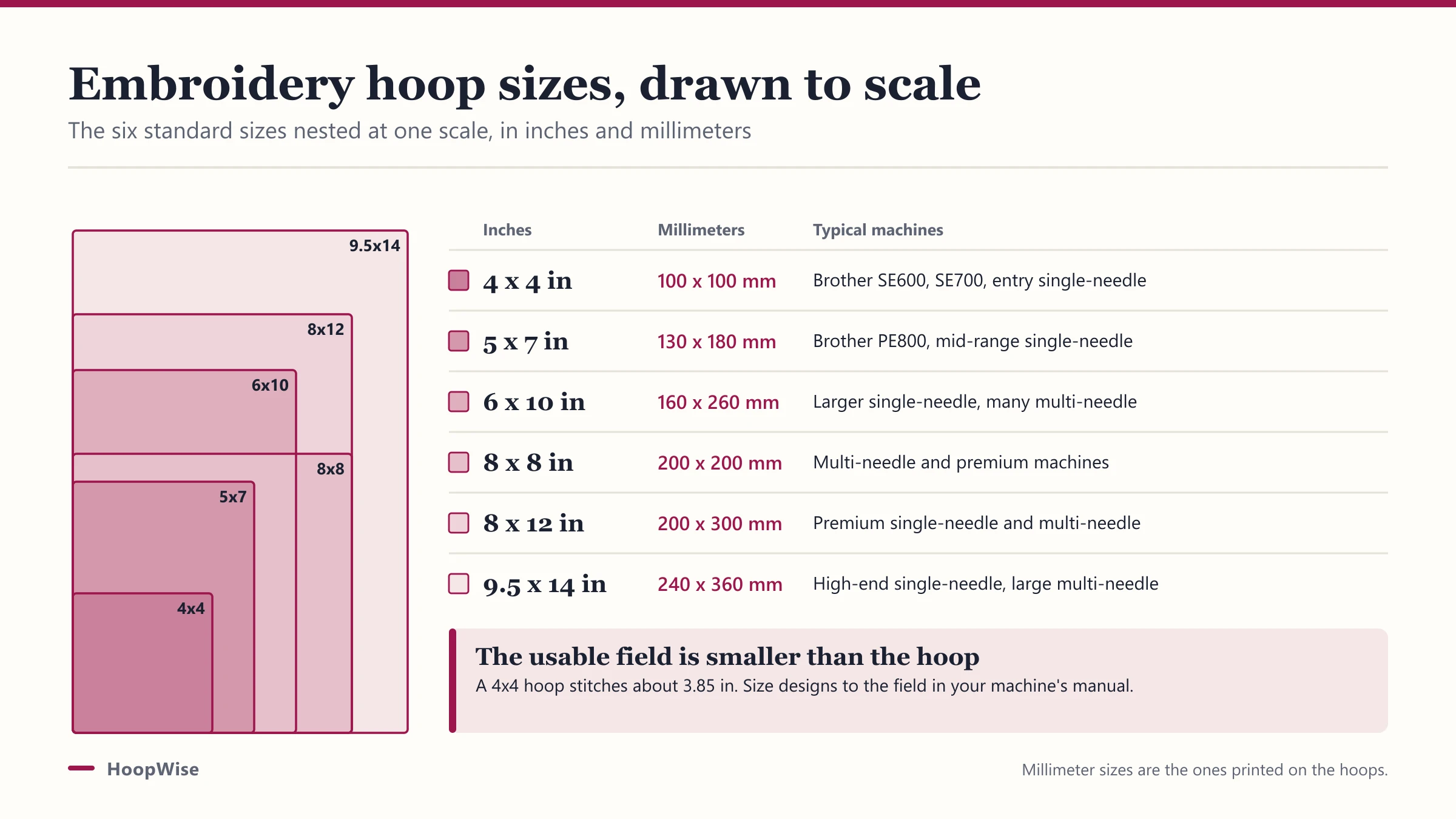
Hoop size decides how big a design you can stitch in one hooping, and it is the number people check first when buying a machine. The sizes cluster around a few standards, but two things trip people up: the usable field is smaller than the hoop, and bigger is not always better. This guide gives the chart and the reasoning.
What are the standard embroidery hoop sizes?
The standard machine embroidery hoop sizes are 4x4 inch, 5x7 inch and 6x10 inch, with larger fields on premium and commercial machines. Sizes are quoted either in inches (US) or millimeters (most of the rest of the world), and the two do not round to each other neatly, so charts list both.
| Hoop size (in) | Hoop size (mm) | Typical machines |
|---|---|---|
| 4 x 4 | 100 x 100 | Brother SE600, SE700, entry single-needle |
| 5 x 7 | 130 x 180 | Brother PE800, mid-range single-needle |
| 6 x 10 | 160 x 260 | Larger single-needle, many multi-needle |
| 8 x 8 | 200 x 200 | Multi-needle and premium machines |
| 8 x 12 | 200 x 300 | Premium single-needle and multi-needle |
| 9.5 x 14 | 240 x 360 | High-end single-needle, large multi-needle |
The millimeter sizes are the ones printed on the hoops themselves, so 4x4 is marked 100x100 and 5x7 is marked 130x180.
Why is the usable field smaller than the hoop?
Because the inner ring and the needle clearance eat into the space the frame encloses. The number on the hoop is the frame size; the embroidery field is the area the needle can actually reach inside it, and it is always a few millimeters smaller on every side.
A 4x4 inch hoop stitches a field of roughly 3.85 inches, not a full 4. A 5x7 inch hoop gives about 5 by 7 minus a small margin. Always size a design to the usable field from your machine’s manual, not to the frame size, or the last row of stitches will run off the edge of what the machine can reach. This is the single most common reason a design will not load into a hoop it looks like it should fit.
Which hoop size should you choose for a design?
Choose the smallest hoop the design fits in, not the largest hoop you own. A smaller hoop clamps a smaller area of fabric, so the fabric is held more firmly and tensioned more evenly, which cuts down on shifting, puckering and registration errors.
A big hoop holding a small design leaves a large span of fabric loose around the stitching, and loose fabric moves. Match the hoop to the design: a 3 inch monogram belongs in a 4x4 hoop, not an 8x8. Keep the bigger hoops for designs that actually need the span. Good hooping technique matters as much as hoop choice; our machine embroidery for beginners guide covers how to hoop fabric and stabilizer together.
What hoop sizes come on common machines?
Entry machines ship with a 4x4 hoop; the jump to 5x7 is the main reason to step up a model. Beyond that, large and multi-needle machines open up 6x10 and bigger fields.
- Brother SE600 and SE700: 4x4 inch (100x100 mm) field, the entry standard.
- Brother PE800: 5x7 inch (130x180 mm), a popular mid-range field.
- Larger single-needle machines: often 6x10 inch (160x260 mm) or more, sometimes with multi-position hoops.
- Multi-needle machines (Brother PR series and similar): tubular hoops in several sizes plus cap frames, which is why they suit volume work.
The hoop a machine ships with sets the ceiling on design size out of the box, so weigh it when buying; our embroidery machine buying guide and beginner machine picks list fields by model.
What about specialty and oversized hoops?
Specialty hoops extend what a machine can do without a bigger field. Cap frames hold the curved front of a hat; border or multi-position hoops reposition the fabric to stitch a design larger than the machine’s single field; and magnetic hoops speed up hooping and handle thick or awkward fabrics.
Multi-position hoops are how a single-needle machine stitches, say, a 10 inch design in a machine with a 5x7 field: the hoop locks into two or more positions and the software splits the design to match. For thick items, hoop burn and repeated screw-tightening, magnetic hoops are often easier; see our magnetic embroidery hoops guide.
Are hoops interchangeable between machines?
Generally no. Hoops attach to a brand’s specific arm and bracket, so a Brother hoop fits Brother machines with that bracket, a Janome hoop fits Janome, and so on. Even within one brand, a hoop has to match the machine’s hoop mounting.
Third-party and magnetic hoop makers produce hoops for specific machine brackets, so a magnetic hoop is sold by the machine model it fits. Multi-needle machines use tubular hoops that are not interchangeable with flat single-needle hoops. Always confirm the hoop is made for your exact model before buying, especially for larger and specialty hoops; see the multi-needle machine guide for how tubular hooping differs.
How do multi-position hoops stitch a larger design?
A multi-position hoop clamps the fabric once and locks into the machine arm in two or more positions, so a single-needle machine can stitch a design taller than its normal field. The software splits the design to match the hoop positions, and you reseat the hoop at each prompt without rehooping the fabric.
This is the common way to stitch a 9 or 10 inch design on a machine with a 5x7 field. Because the fabric never leaves the hoop, registration stays better than rehooping by hand would give. The trade-off is that the fabric must be hooped large enough to cover every position, and alignment between positions has to be exact, so multi-position work rewards careful hooping. For true volume and the largest single-pass fields, multi-needle machines with large tubular hoops are the step up; see the multi-needle machine guide.
How do you check a design against your hoop?
Compare the design’s width and height to your machine’s usable field, in the same units, before you load it. Every design lists its dimensions, and every machine lists its field in the manual; if the design is larger than the field in either direction, it will not stitch in one hooping.
| If the design is… | Then… |
|---|---|
| Smaller than the field | It loads; use the smallest hoop it fits |
| Larger in one direction | Rotate it 90 degrees if that fits, or split it |
| Larger than any single hoop | Use a multi-position hoop or split the design in software |
| Much larger | Make it a patch, or use a larger or multi-needle machine |
Remember the field is a few millimeters smaller than the hoop, so a design that is exactly 4 inches will not fit a 4x4 hoop. Size designs to the field with a small margin to spare. Our beginner guide shows loading and sizing a first design.
Who does not need a large hoop?
- Monogram and lettering embroiderers. Names, left-chest logos and small motifs fit a 4x4 hoop, and a smaller hoop holds them better.
- Beginners. Learn on the 4x4 that came with the machine before spending on larger hoops you may not use.
- Patch makers. Patches are small by design, and the stitch field rarely limits them; see how a 4x4 handles patches up to about 3.85 inches.
Buy a larger hoop when a real project needs the field, not in advance. A 5x7 is the most useful second hoop for most people.
Sources: Brother USA machine specifications (SE600, SE700, PE800 hoop sizes and fields); hoop markings in mm (100x100, 130x180, 160x260); machine manuals for usable embroidery field dimensions; multi-needle and cap-frame documentation from Brother PR-series materials.
Frequently asked questions
Quick answers to what readers ask us most
What is the most common embroidery hoop size?
The 4x4 inch (100x100 mm) hoop is the most common, because it is the standard hoop on entry-level machines such as the Brother SE600 and SE700. The next step up, 5x7 inch (130x180 mm), is the most useful second size and ships on mid-range machines like the Brother PE800.
Is the hoop size the same as the design size?
No. The usable stitch field is a few millimeters smaller than the hoop frame, because the inner ring and the needle clearance take space. A 4x4 inch hoop typically stitches a field of about 3.85 inches, so size designs to the field, not the frame.
Can I use a bigger hoop for a small design?
You can, but a smaller hoop holds the fabric more firmly and is less likely to let it shift, which reduces puckering and registration problems. Use the smallest hoop the design fits in rather than the largest hoop you own.
Are embroidery hoops interchangeable between brands?
Mostly no. Hoops attach to a brand's specific arm and bracket, so Brother hoops fit Brother machines and so on. Some third-party and magnetic hoops are made to fit specific machine brackets, so check the fit for your exact model before buying.
What size hoop do I need for a shirt back or jacket?
A large design like a jacket back needs a large field, typically 6x10 inch (160x260 mm) or bigger, which is why those designs are usually stitched on machines with large hoops or on multi-needle machines. On a 4x4 machine you split the design or make a patch.